
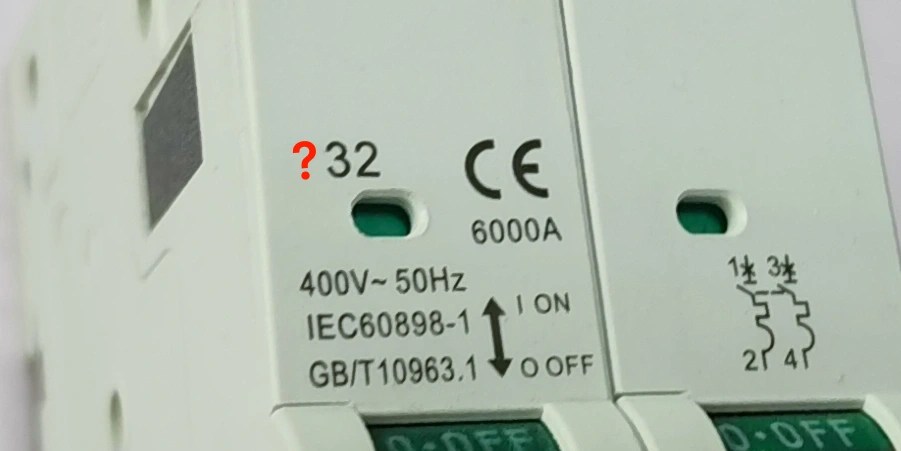
I’ve only come across this question once so far, but I can understand why an engineer might ask it when looking at a datasheet and wondering if there’s a way to make a breaker behave exactly the way their circuit needs.
Typically, the answer is no, at least not in the way people usually imagine it. A standard MCB has its trip curve set at the factory, with no dial or switch for adjusting it afterward.
What you can do is choose an MCB with a trip curve that already matches your load. That’s really what “customizing protection” means in this world: you’re not tuning a knob, you’re choosing the right characteristic—or, in some cases, asking a supplier to build something that isn’t available off the shelf.
Why the Trip Curves Are Fixed?
The reason MCBs don’t allow field adjustment comes down to safety and product consistency.
The trip mechanism is part of the breaker’s internal design and has been tested as part of the complete product. Once the unit has been tested and certified, its safety and performance are based on that original design and configuration.
If someone opens the breaker and modifies the trip mechanism, the actual product may no longer perform in the same way as the one that was originally tested. Its trip characteristics, protection performance, and overall safety can no longer be guaranteed. Such modifications may also create a compliance issue.
This is also why we tell customers not to try modifying an MCB themselves to stop nuisance tripping.
Swapping to a higher curve just because a breaker keeps tripping might solve the annoyance, but it can leave the circuit under-protected.
A D-curve breaker tolerates a much higher inrush before it trips instantaneously than a C-curve does. If the actual fault current in that circuit isn’t high enough to trigger the D-curve’s magnetic threshold quickly, you’ve created a slower, less reliable disconnection than the original design called for.
The fix isn’t to change the curve arbitrarily. It’s to size the breaker against the real load and fault current from the start.
What This Means for Engineers?
If you’re designing equipment and you know the inrush characteristics of your load, the smarter move is to select the curve during the design phase rather than discovering a mismatch after the product ships.
This is especially true for hardware that gets exported to different markets, where local grid conditions and prospective fault currents can vary.
A curve that works fine in one country’s grid might not clear a fault fast enough in another.
Why B, C, and D Curves Aren’t Adjustable?
Most of the MCBs we sell day to day are B, C, and D curve breakers, with C-curve being by far the most common. We do get orders for B and D curves, but they are much less frequent and usually come up when the load characteristics or application are more specific.
So in most of the projects we deal with, there’s no real need for some complicated way to adjust the trip curve. The more common question is whether the standard curve actually matches the customer’s load.
The trip characteristic is tied to the design of the magnetic trip mechanism, the mechanical structure, and the calibration of the relevant components inside the breaker. For a standard product, keeping the trip curve fixed at the factory makes it much easier to maintain consistent performance from one breaker to the next.
Why don’t manufacturers just make it adjustable?
From an engineering perspective, adjustable doesn’t necessarily mean better.
If users could freely change the operating threshold of the magnetic trip mechanism, the actual protection characteristics of the breaker would change as well. An MCB isn’t a component where you only need to verify the rated current. Its trip characteristics, short-circuit protection, temperature rise, mechanical performance, and other parameters all have to be tested with a specific product configuration.
For products tested and certified to IEC standards, this is one of the main reasons manufacturers don’t provide a way for users to freely adjust the trip curve.
When Z and K Curves Enter the Picture
Here’s where things get more interesting, and honestly, more educational for me too. Beyond B, C, and D, there are Z and K curve breakers. Z-curve trips at an even lower multiple of rated current than B, somewhere around 2 to 3 times, which makes it suited for very sensitive electronic circuits. K-curve sits in a range built for specific motor protection profiles. Big international brands like ABB and Schneider carry these in their catalogs, but they’re far less common, and almost nobody in the Yueqing industrial cluster make them.
For a long time, I only knew Z and K curves existed because I’d read about them, not because a customer had ever asked. That changed when we got a request from a company specialized EV chargers. They needed a Z-curve breaker, with overload protection already handled by another component in the system. The breaker only needed to provide short-circuit protection.
That was a first for us. We ended up modifying one of our standard models to meet the spec, and it passed the customer’s technical testing. It was a small project, but it told me something bigger: even a product as common as an MCB has pockets of demand nobody is filling, simply because the volume is too small for most factories to bother with.
For more details, please check the card link below:
Why bigger factories skip these requests?
I asked a few people in the industry later whether they’d taken on similar projects, and the answer was consistently no. Low-volume, non-standard curve requests are more work to fulfill and don’t generate enough order size to be worth the hassle for most manufacturers.
That’s a rational business decision if you’re running a high-volume production line built around standard SKUs. But it also means that demand for these unusual curves doesn’t disappear, it just goes unmet, or gets absorbed by big brands charging a premium for catalog items that smaller buyers may not be able to afford.
We ran into the limits of this ourselves. A large company in Iran once asked us for a Z-curve breaker rated at 2A. We only had a path to modify existing components down to 6A, nothing lower, so we couldn’t fulfill that particular request, and the customer ended up buying from Schneider instead.
I mention this not to make us sound more capable than we are, but because it’s a fair example of where the line currently sits for a small manufacturer like us: we’re not a large factory, but we’re also not a small workshop, so we can take on more custom work than a standard-parts factory, but there’s still a floor.
What Happens When You Ask a Factory for Something Non-Standard?
If you bring a non-standard trip curve request to a typical manufacturer, you’ll usually run into one of two responses. Either the factory tells you it isn’t possible, because their tooling and calibration process is built entirely around a handful of standard SKUs, or they quote an MOQ so high that a mid-size buyer can’t justify it. Neither answer is wrong exactly, it’s just a reflection of how most breaker manufacturing is set up: high volume, low variation, tight margins on standard parts.
There’s also a real technical reason non-standard requests get turned down. Building a breaker with a different trip threshold isn’t just a matter of swapping a spring or a coil, it usually means adjusting the internal thermal-magnetic assembly and then retesting the unit to confirm it behaves the way it’s supposed to across its full operating range. That takes engineering time and test equipment, and if the order is only a few thousand pcs, it’s hard for a large factory to justify pulling a production line to accommodate it.
What a small factory can offer instead?
This is where a supplier that sits between the big factories and the small workshops has an advantage. We don’t run the volume that a first-tier manufacturer does, but we also don’t have the constraints a tiny workshop has around technical documentation, English communication, or test reporting.
When a customer comes to us with an uncommon spec, whether that’s a Z-curve, a K-curve, or a custom current rating, we can usually get through a couple of rounds of prototyping without the process turning into a multi-month ordeal.
That doesn’t mean every request gets fulfilled. As the Iran example shows, there are limits to what we can modify from existing components. But it does mean the conversation is worth having, because you won’t know where the limits are until you actually ask.
Why testing reports matter here?
One thing worth flagging: if a factory offers to build you a custom trip curve but can’t produce a test report showing the modified unit’s actual performance, be cautious.
A custom breaker without documented test data is a liability, not a solution. You want to see the instantaneous trip range confirmed under test conditions, not just taken on the factory’s word.
Working With a Supplier on Custom Protection Parameters
If you’re going to pursue a non-standard trip curve, or any custom electrical parameter, the process works better when you come prepared. Vague requests like “we need something more sensitive” waste time on both sides. Specific numbers move things forward.
Here’s a rough version of what a productive conversation with a supplier usually needs to cover:
| Information Needed | Why It Matters |
|---|---|
| Rated current and voltage | Sets the baseline breaker size |
| Desired trip curve or multiple of rated current | Defines the instantaneous magnetic threshold |
| Application and load type | Helps assess whether the request is technically achievable |
| Target volume per year | Determines whether custom tooling or manual modification makes sense |
| Certification requirements (CE, CB, SAA, etc.) | Confirms which markets the finished product can legally enter |
Once we have this, we can usually tell fairly quickly whether a request falls into “modify an existing platform” territory or “this needs a different kind of device entirely,” like an MCCB or an electronic-trip breaker with adjustable settings.
Being upfront about that distinction early saves everyone from chasing a solution that was never going to work with a standard MCB body.
Prototyping and Sample Rounds
For most custom trip curve projects, we go through one or two rounds of samples before locking in a final spec. The first round usually surfaces something, a threshold that needs adjusting, a housing clearance issue, something the drawings didn’t fully capture.
That’s normal. The engineers who get the best results are the ones who treat the first sample as a checkpoint, not a final answer, and give specific feedback rather than a general “it’s not quite right.”
Choosing the Right Manufacturing Partner for Non-Standard MCBs
Not every supplier is set up to handle this kind of request, and it’s worth being honest about what to look for before you commit time to a back-and-forth that goes nowhere.
The first thing to check is certification. A factory can claim it makes custom breakers, but if it doesn’t have CB, CE, SAA documentation for the base platform it’s modifying, you’re taking on compliance risk that will show up later, possibly at customs, possibly during an audit by your own customer.
The second thing is communication. Non-standard requests involve technical back-and-forth: drawings, tolerances, test data. A supplier that struggles to read an engineering drawing or communicate clearly in English is going to slow the project down regardless of their actual manufacturing capability.
This sounds obvious, but it’s one of the most common breakdowns we hear about from customers who tried working with smaller workshops first.
What to ask before you commit
A few direct questions tend to separate suppliers who can actually deliver from those who are just saying yes to close a sale:
- Can you show me a test report from a similar custom project you’ve completed before?
- What’s your minimum order quantity for a modified trip curve, and does it change based on the rating?
- How many sample rounds are typically needed before you lock in a spec?
- What certifications does the base platform already carry?
If a supplier can’t answer these clearly, that’s useful information too. It tells you they may be willing to try, but they haven’t done this enough times to know their own process.
The market for non-standard MCBs is small, which is exactly why most manufacturers ignore it. But small doesn’t mean nonexistent, and if you’re an engineer who has run into a mismatch between what’s on the shelf and what your project actually needs, it’s worth having the conversation.
Bring your numbers, ask direct questions, and don’t be afraid to test a supplier’s claims against a real sample before committing to volume. That’s how we’ve found most of our non-standard projects worth doing, one specific request at a time.
Final Thoughts
For buyers and engineers alike, the real takeaway is simple: standard curves cover most loads, and for the rest, a conversation with the right supplier is worth having.
Just go in with specific targets and a healthy respect for certification. That way, even if the answer is no, you learn something useful about your own requirements.