
Custom Low Heat Z-Curve MCB for a Swedish EV Charging Station Manufacturer
case StudyThe project required a balance between reliable protection and low heat generation in a compact enclosure.
Finding the right solution was not easy, as the customer’s requirements went beyond what standard products could offer.

- LocationSweden
- IndustryEV Charging
- ChallengeThermal Management
- ProductCustom Z-Curve MCB
Higher-Power EV Charging Creates New Demands on Circuit Protection
The global EV market is still growing. According to the International Energy Agency (IEA), more than 20 million electric cars were sold worldwide in 2025, making up about one in four new cars sold. In Europe, EV sales grew by more than 30% in the same year. (Source: IEA – Global EV Outlook 2026: Trends in electric cars)
More EVs also mean more charging infrastructure. In 2024, more than 1.3 million public charging points were added worldwide, up by more than 30% from the previous year. (Source: IEA – Global EV Outlook 2025: Electric vehicle charging)
As charging systems become more powerful, they need to handle higher currents. For an MCB, higher current also means more heat during normal operation. This can become a bigger problem when the MCB is installed in a small enclosure with limited space for heat to escape.
For higher-power EV charging systems, keeping the MCB’s heat generation under control can be an important part of the design.
A Thermal Challenge Inside a Compact EV Charging System
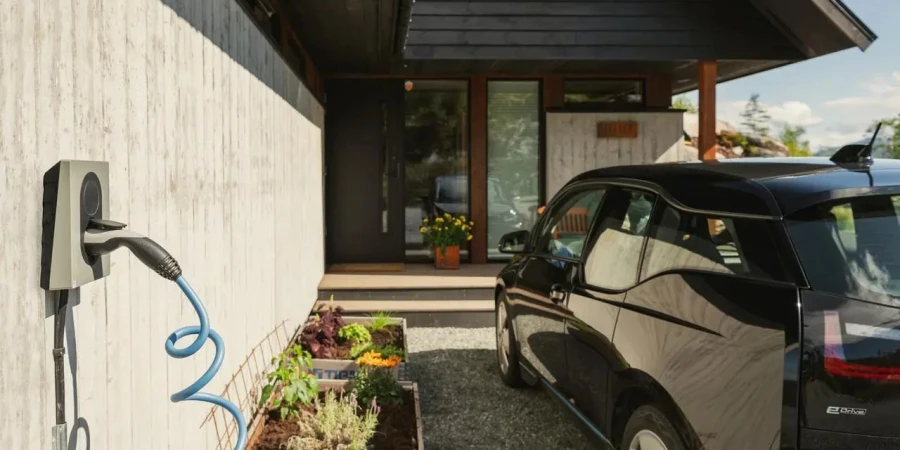
Our client is a Swedish manufacturer of EV charging equipment, developing charging solutions for residential, commercial, and public applications.
For this project, the charging equipment operated inside a compact enclosure with limited space and potentially high ambient temperatures. The system required a continuous 63A load, making MCB heat generation an important consideration.
Overload protection was already handled by other components in the circuit. The main concern was therefore minimizing MCB heat during continuous 63A operation. As an initial approach, the customer considered a higher-rated MCB, such as an 80A or 100A version, to provide more thermal headroom.
The client ultimately needed a Z-Curve MCB that could handle the required current while keeping heat dissipation as low as possible.
Original Requirements
To manage heat generation and control component cost, the client initially considered two possible approaches.
- Optional thermal element Omit the thermal element to reduce component cost and heat dissipation.
- Higher-rated thermal elementUse a higher-rated element, such as 80A or 100A, to reduce thermal stress at the required 63A continuous load.
Technical Requirements
- Configuration3 Poles
- Rated Current63A
- Trip CurveZ-Curve · 2–3 × In
- InstallationStandard DIN-Size
Our Approach
To meet the customer's thermal requirements without compromising the required protection characteristics of the MCB, our R&D team developed the solution through two rounds of engineering optimization.
Remove the Thermal Element
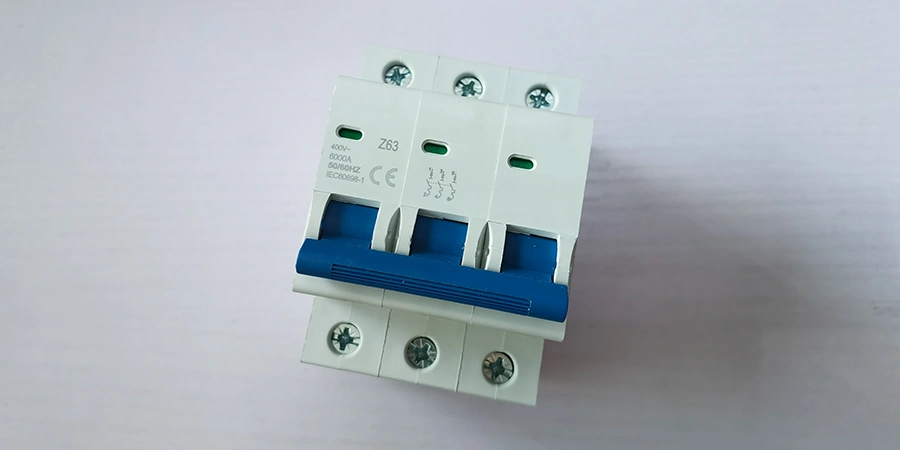
Round 1Z-curve MCBs are relatively uncommon, so we did not have a standard Z-curve model available. Our R&D team started with a conventional MCB and modified it by replacing the iron core to achieve the required Z-curve magnetic trip characteristics.
To hit their heat target, we also removed the bimetallic thermal overload element entirely and kept only the magnetic trip mechanism. This lowered internal resistance and cut heat generation significantly.
Customer Feedback
The client tested the first sample in their lab. They liked what they saw — but they also found room for improvement. Here‘s their feedback:
We did some power-dissipation tests, and it performs at about 4.2 W per pole at 63 A which is pretty good. At 10 A, most of the power-dissipation (59 %) came from the actual contact point which we also easily damaged by high current breaking since it has ball form, small contact area and seem to have thin layers of contact protective materials. Calculating from measurements at 63 A the contact point generates roughly 40 % of the heat dissipation.
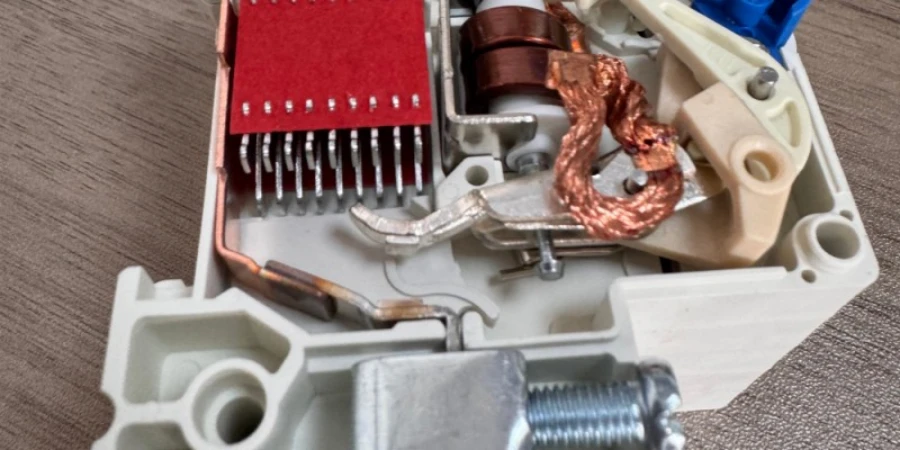
The inner parts of the MCB looks sturdy and well dimensioned. Coil with flat conductor looks good. Braids are thick or doubled. So, I think the construction looks very good… Could anything be done to the contact point? Specially making it sturdier for long time use…
As of now, I like the samples. Sure, the heat-dissipation in the contact point is higher than expected, but the lifespan of the contact point is very important to us.
What the First Test Revealed
Heat concentration
At 63 A, the contact point generated roughly 40% of the total heat dissipation measured by the customer.
Small contact area
The original ball-shaped contact had a small contact area, resulting in higher localized heat generation.
Durability concern
The contact point showed wear during high-current breaking, raising concerns about long-term contact durability.
Change the Contact
Round 2The first sample performed well overall, but the contact point remained the main concern. It contributed significantly to heat dissipation and showed signs of wear during high-current breaking.
Based on the customer’s feedback, we replaced the original contact with a different contact solution designed to improve both heat performance and durability. We then produced a new sample and shipped it to customer for testing.
Customer Feedback
Yes, thank you! We have tested the new sample with better contact and it performs 15-20 % better heat wise, which is quite a lot and in our application where heat matters a lot. This is important. So I think we are happy technically now and can move on to the next step.
The Results
Lower Heat Dissipation
The new sample showed 15–20% better heat performance in the same power-dissipation test.
Better Contact Performance
The new contact helped reduce heat generation and improved performance during high-current testing.
Ready for the Next Step
The customer was satisfied with the technical results and ready to move forward with the next step.
Final Words
When the customer first contacted us, one of our sales colleagues handled the inquiry as usual and sent them our standard product catalog. Since the customer’s requirement was non-standard, we did not have a suitable product to offer at that point. After receiving the catalog, the customer did not reply, so we assumed they had decided to look for another solution.
Later, the customer came back to us. They had continued looking for a suitable Z-curve MCB, but most manufacturers they contacted only offered standard B, C, and D curves. Z-curve MCBs are relatively uncommon, and only a few major manufacturers, such as ABB and Schneider Electric, have them as standard products. In this case, the customer also needed to deal with the thermal element, while the order volume was not very large. Developing a completely new product could mean a long lead time and a high cost, making the project difficult to move forward.
The customer was clearly under some pressure. Without a suitable MCB, their project could not continue. So when they came back to us, we decided to give it a try. We asked our technician to start with a conventional MCB and modify it for their application. We changed the internal structure, replaced the iron core to achieve the required curve characteristics, and removed the thermal element to reduce heat generation.
To be honest, this was also a new attempt for us. We were not sure at the beginning whether the solution would fully meet the customer’s needs.
This project also made us think about how many customers may be looking for products that are simply not available in standard catalogs. Sometimes the quantity is too small, sometimes the development work seems too complex, and sometimes it is simply easier for a manufacturer to say, “We don’t make that.”
We understand why manufacturers make that choice. But behind a small non-standard order, there may be a customer who is worried because they simply cannot find a solution for their project. If you are facing a similar problem, feel free to talk to us to explore the possibilities.
Have a Non-Standard MCB Requirement?
Share with us your project details. We'll take a look and see if there’s a practical solution we can help you develop.