
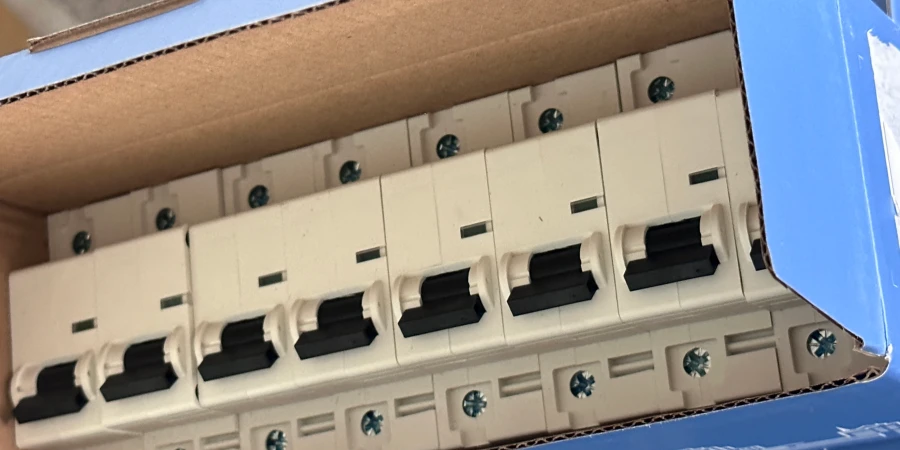
When customers looking for MCBs from China for the first time, they are often understandably cautious. Some already have preconceived ideas about “Made in China,” assuming it means cheap, poorly made, or unreliable products. If I were buying from a distant country for the first time, I’d probably have similar concerns.
But the truth is, “Made in China” tells you very little on its own. What matters is the specific model, the certificates behind it, and whether those certificates can actually be verified against the manufacturer’s name.
I’ve seen buyers become suspicious simply because a product was made in China, while others have been fooled by a fake CE mark on a breaker that never actually went through laboratory testing. So when judging whether an MCB is reliable, don’t just look at where it was made. Look at the product itself and the evidence behind it.
How Can I Tell If a Chinese MCB Is Actually Reliable?
You can tell by checking the model first, not the label. A reliable MCB has a model number and specifications that can be matched to the manufacturer’s official datasheet and test certificate. More importantly, the exact configuration you’re buying — including the rated current, pole configuration, trip curve, and other relevant specifications — should fall within the scope of the certificate.
If the configuration you’re buying falls outside that scope, don’t assume the certificate automatically applies just because the product looks similar or belongs to the same series.
What separates a reliable unit from a risky one
Some Chinese manufacturers run the same quality systems you’d find in a German or French plant. Let’s say a famous example, CHINT’s NB1-63H, carries a DEKRA/KEMA-KEUR certificate built on EN 60898-1:2019, backed by factory inspection and stated compliance with IEC 60898-1:2015.
That’s not a marketing claim. That’s a document you can pull up and cross-check (chintglobal). Other Chinese-made breakers carry CB Scheme certificates issued through TÜV Rheinland, and those can be checked directly in the IECEE certificate database rather than taken on faith.
At the same time, I won’t pretend every factory in this country operates that way. Yueqing alone has thousands of electric component factories, and the gap between the top tier and the bottom tier is enormous. Some plants run full type-testing and batch traceability. Others buy a few certified samples, send those off for testing, and then produce the bulk order with cheaper contacts, thinner arc chutes, or loosely controlled trip mechanisms. The certificate you saw in the sales deck was real. The product in your container might not match it.
An MCB isn’t a light switch. It has to carry your normal load without heating up, trip predictably when something goes wrong, and interrupt a short circuit fast enough to prevent damage or fire. A breaker that looks correct but performs inconsistently under fault conditions is a liability sitting inside your panel, waiting for the one day it matters.
| Signal | Reliable manufacturer | Risky manufacturer |
|---|---|---|
| Model traceability | Printed model matches datasheet exactly | Model number vague or missing |
| Certificate scope | Covers the exact configuration you’re buying | Covers a different pole count or rating |
| Batch consistency | Trip curve and Icn controlled across production | Only initial samples were ever tested |
| Documentation | Test reports available on request | “Trust us, it’s certified” |
What Certifications Should I Check Before I Buy MCBs From China?
Certifications matter, but only the kind you can independently confirm. A logo printed on plastic proves nothing by itself.
What proves something is a certificate number you can look up with the issuing body, tied to the exact model, voltage, pole configuration, and rated current you intend to buy.
Reading a certificate the right way
For most residential and light commercial installations, the standard you want is EN/IEC 60898-1, which covers circuit breakers for household and similar installations. Industrial applications sometimes fall under IEC 60947-2 instead, and the two shouldn’t be treated as interchangeable without someone reviewing the actual duty and fault conditions the breaker will face. If a supplier can’t tell you which standard applies to your project, that’s already worth pausing on.
CB Scheme certificates are a good starting point because they’re issued through IECEE-recognized labs and can be verified in a public database. CE marking by itself is not evidence of independent third-party testing. It shows that the manufacturer declares the product complies with the applicable requirements, but it does not mean an independent lab has confirmed that compliance.
A proper EU Declaration of Conformity should name the exact model and list the directives and standards it meets. If a supplier only sends you a PDF with a logo and no model-specific data, ask for the real document.
Here’s a rough guide to what each certification actually confirms:
| Certification | What it verifies | What it doesn’t verify |
|---|---|---|
| CB Scheme (IECEE) | Third-party lab tested this exact model | Ongoing batch consistency |
| CE marking | Manufacturer declares compliance | Independent lab testing |
| CCC | Meets Chinese national safety requirements | Compliance with EU/AU standards |
| SAA | Approved for the Australian market | Nothing about UL or EU markets |
| UL | Approved for US/North American market | Nothing about CE-region compliance |
One thing worth knowing about our own factory: We don’t carry UL, and honestly, most small and mid-sized factories along our industrial belt don’t either — UL testing and ongoing surveillance are expensive, and it only makes sense if you’re actively shipping into the US or Canada. (Related Reading: What If a Chinese Supplier Does Not Have UL Certification?)
If your target market is Europe, the Middle East, or Australia, CB and CE cover the compliance ground you actually need. If UL is a hard requirement for your project, that’s worth flagging early, because it changes which factories can serve you.
How Can I Verify The Breaking Capacity And Trip Performance of My Chinese MCBs?
This is where many buyers stop too early. They see “6 kA” printed on the breaker and assume that settles it. It doesn’t.
A breaking capacity number is only meaningful when it’s backed by a genuine type-test report for that exact model, because an incorrect rating creates real danger during a short circuit — the breaker either fails to interrupt the fault safely or degrades in a way that isn’t visible from the outside.
Why batch testing matters more than sample testing
A trip curve describes how fast the breaker responds to overload versus short-circuit current. Getting this wrong doesn’t just mean a nuisance trip. A D-curve breaker on a circuit that needed a B-curve might not trip fast enough during a fault, or might nuisance-trip constantly if the mismatch runs the other way.
The rated current, the curve, and the breaking capacity all have to match the actual cable, load, and prospective fault current at that specific point in the installation. No breaker is “safe” in the abstract — it’s only correctly specified or incorrectly specified for a given circuit.
Here’s the part that separates a manufacturer worth working with from one that isn’t: does the factory test only the samples it sends for certification, or does it control thermal and magnetic trip characteristics across ongoing production?
A reliable plant runs routine testing on production batches, not just on the units that get shipped off to a lab once. That’s the difference between “this design passed a test in 2022” and “this unit you’re holding right now will perform the way the datasheet says.”
For OEM orders or anything at meaningful volume, I’d always recommend batch sampling and independent lab verification before the goods leave China, especially on a first order with a new supplier. It costs a little time and a modest fee, and it tells you whether the product in the container matches the approved sample — rather than finding out after it’s already installed in someone’s panel.
| Verification step | What it catches |
|---|---|
| Request the type-test report | Confirms the rated Icn is genuine, not just printed |
| Ask for batch/lot traceability | Lets you trace a fault back to a specific production run |
| Third-party pre-shipment inspection | Confirms goods match the approved sample before shipping |
| Cross-check trip curve on datasheet | Confirms B/C/D curve matches your circuit design |
Should I Test MCB Samples Before Placing a Bulk Order in China?
Yes, and I’d go further: for a first order with any new supplier, sample testing isn’t optional, it’s basic due diligence.
A sample that performs well on the bench tells you the design is good. It doesn’t tell you the factory can reproduce that performance across five thousand units three months later. Those are two different questions, and skipping the second one is where a lot of bulk orders go wrong.
What sample testing actually protects you from
Think about what changes between a sample run and a production run. A sample gets extra attention — someone on the line hand-checks the contacts, the assembly is done carefully, maybe even by a senior technician instead of the regular shift. A bulk order runs at normal speed with normal staffing. If a factory’s quality control depends on extra attention rather than a controlled process, the gap between sample and bulk shows up in exactly the specs that matter most: trip timing, breaking capacity, terminal torque retention, insulation resistance.
A practical approach looks like this: order a small pilot batch, not just individual samples, and have an independent lab run the core tests — overload trip time, short-circuit interruption, dielectric strength, and mechanical endurance on the switching mechanism. Compare the results against the certificate the supplier gave you. If the numbers match, you’ve confirmed the factory can hold its own standard at scale, not just under lab conditions.
If your project isn’t small, I’d genuinely recommend you to fly out and visit the factory yourself. Walk the production floor. Talk to the people actually running the line, not just the sales contact. You’ll learn more in half a day standing next to the assembly line than you will from another month of email exchanges. It’s not something every supplier will be comfortable with, and that discomfort itself tells you something.
| Testing stage | Purpose | When to do it |
|---|---|---|
| Certificate review | Confirms design was tested and passed | Before any order |
| Sample bench test | Confirms sample matches spec | Before first order |
| Pilot batch lab test | Confirms production process holds spec | Before scaling to full volume |
| Ongoing batch sampling | Confirms consistency continues | Every reorder, especially early ones |
For big OEM programs, I’d also ask the supplier directly how they control batch consistency — not whether they do, everyone says yes, but how.
A factory that can walk you through its actual process, including where things sometimes go wrong and how they catch it, is telling you more than one that just repeats “we have strict QC” without specifics.
How Can I Choose a Chinese MCB Supplier Without Sacrificing Quality For Price?
This is the question underneath all the others, and I won’t give you a shortcut, because there isn’t one. The honest version is this: price and quality both come from real decisions a factory makes about materials, testing, and staffing, and you can usually reconstruct those decisions if you ask the right questions instead of just comparing quotes.
Reading between the lines of a quote
A quote that comes in far below the market deserves a closer look. The difference may come from materials, testing, certification, production efficiency, or simply a different margin structure. The price alone won’t tell you which one it is.
What matters is whether the supplier can explain the difference and back it up with documentation, testing, and a consistent production process. A fair price should leave enough room for proper materials, certification, quality control, and the ongoing support you expect from a long-term supplier.
I won’t pretend our prices are the lowest you’ll find, because they’re not, and I don’t try to compete on that basis. We don’t cut corners to win an order, which means a buyer motivated purely by unit cost can usually find someone cheaper somewhere else. That’s fine. It’s just not the customer relationship we’re built for. What we do instead is stay in the range where the certifications are real, the testing is ongoing, and the factory is still going to be answering your emails three years from now.
That said, don’t assume a small factory automatically means lower quality. A lot of the big brand names you know are actually made under contract by smaller factories exactly like the ones scattered across our industrial belt here in Yueqing.
A small plant that’s survived ten years or more in this business usually knows what it’s doing — the ones that don’t tend to disappear within two or three years. The catch is that these factories are often genuinely hard to find. Their attention goes into production, not marketing, and some don’t have anyone on staff who speaks English at all.
Here’s a simple framework I’d use when comparing suppliers, whether it’s us or anyone else:
| Question to ask | What it reveals |
|---|---|
| Can you show me the certificate for this exact model? | Whether certification is real or borrowed from a different SKU |
| How do you control consistency batch to batch? | Whether QC is a process or a slogan |
| Can I visit the factory or speak with the engineering team? | Whether the supplier is confident in what they’re showing you |
| What happens if a batch fails inspection? | Whether there’s an actual recovery process, not just an apology |
| Is your price close to the certification and testing cost, or well below it? | Whether the margin makes long-term support realistic |
If a supplier can answer all five without hesitation, you’re probably looking at a legitimate manufacturer, whatever the country of origin. If they dodge two or three of them, the price starts to make a lot more sense.
Final Thoughts
You can trust a Chinese-made MCB, but don’t trust the country label alone. Check the specific model, certificate, breaking capacity, trip curve, and whether the supplier can provide documentation you can actually verify.
For safety-critical projects, my rule is simple: verify the product, test the first batch, and work with a supplier who can answer the hard questions. Do that, and where the MCB was made becomes much less important.