

Many buyers sourcing from Yueqing find that UL-certified suppliers are surprisingly hard to come by. Walk through the industrial zones and you will see factories turning out millions of breakers—most with CE or CB, few with UL.
That leaves buyers in a difficult position. You need a breaker that will pass inspection, but the suppliers who look good on paper often do not carry the right certification for your market.
So what do you do?
Importing and Installing Are Not the Same Approval
You can bring a non-UL circuit breaker into the United States. Customs does not check for a UL mark at the border, and nothing stops the shipment from landing. The trouble starts the moment someone tries to put that breaker into a live panel that an inspector will look at.
Most US states build their electrical code around the National Electrical Code, and that code asks for listed equipment on branch circuits. The person enforcing it is the local Authority Having Jurisdiction, and they check the panel, not the customs paperwork, which is why some buyers assume the two approvals are one and the same when they are not.
A molded-case breaker used to protect a branch circuit needs a UL 489 listing, full stop. An IEC 60947-2 certified breaker, which is what most of our product line carries, does not satisfy that. And UL 1077 gets mixed up with UL 489 constantly — 1077 covers supplementary protection sitting inside equipment that already has UL 489 or fuse protection ahead of it, so it is not a swap-in replacement for a primary breaker.
| Market | Common standard requested | Typical certification |
|---|---|---|
| US / Canada (branch circuit) | NEC-listed equipment | UL 489 |
| Europe / IEC markets | IEC 60947-2 | CE, CB |
| Australia / New Zealand | AS/NZS standards | SAA |
What Actually Goes Wrong Without a UL Listing?
An inspector can reject the panel on the spot. That is the plain version of it, but the ripple effects go further than one failed inspection.
Insurance carriers for commercial buildings will often ask for UL-listed equipment as a condition of coverage, so a breaker without the mark can hold up a certificate of occupancy long after the wiring is done. Panel builders working under a UL 508A listing face an even harder line, because their own listing requires every component inside the panel to be UL Listed or Recognized, so a non-UL breaker simply cannot go in, no matter how well it performs on paper.
I hear the same story directly from buyers, and it usually goes like this: a US or Canadian purchaser emails asking for a UL-listed breaker, and when we say we don’t have UL certificate, the customers doesn’t reply anymore.
It is not that our product falls short on performance — it is that without the certificate, we do not even get considered. So while UL is technically a voluntary mark rather than a legal import requirement, in practice it works as a hard gate for anyone selling into commercial or industrial installations in North America.
Why Most Small Factories in Our Industrial Belt Don’t Carry UL?
You might wonder why a factory would skip a certification that can open the door to the North American market. The simple answer is cost — and it is higher than many buyers expect.
Getting and keeping a UL 489 listing can cost tens of thousands of US dollars a year once recurring factory audits and other certification costs are included. Ul may also require up to four inspection visits each year to keep the listing active. For a factory our size, in a cluster where most neighbors are also small and mid-sized workshops, that expense only makes sense if the North American order volume is already there to support it.
Only few larger factories in our area do have UL on selected product lines, usually just the small circuit breaker category, but it is far from a standard requirement across the industry, and many small workshops around us have never applied for it at all.
What to Check Before You Place an Order
If you are buying for North America and a supplier tells you their breaker is UL listed, don’t take the claim at face value — verify it yourself.
The UL mark on the physical product is the first thing to look for, and the second is confirming that listing in UL’s own online certification database, since the mark itself is the only reliable proof a listing actually exists. Beyond that, ask the supplier a short set of direct questions before you commit to an order.
| Question to ask | Why it matters |
|---|---|
| Can you provide the UL file number? | Lets you look up the listing directly in UL’s database |
| Which specific product line is listed? | Certification is often per-category, not company-wide |
| Who pays for and manages the quarterly audits? | Confirms the listing is actually being maintained |
| Is the breaker UL 489 or UL 1077? | Determines if it can be used as a primary branch breaker |
If your project sits outside North America, or it’s a personal or low-voltage application rather than an inspected commercial installation, a well-made IEC or CE-certified breaker is often a perfectly practical choice, and it’s worth having that conversation with your supplier before ruling anything out.
CE and CB Are Not a Downgrade, Just a Different Passport
A lot of buyers treat CE and CB certification like a consolation prize, something you settle for when UL isn’t available. That framing doesn’t hold up once you look at what each certification is actually built for.
CE marking and IEC 60947-2 based CB certification cover a completely different set of markets — most of Europe, the Middle East, and a long list of countries that recognize the IEC standard rather than the American one. A breaker built and tested to these standards isn’t a lesser version of a UL breaker. It is built to a different rulebook designed for a different electrical system.
The two families of standards differ because they are written around different grid voltages, fault current expectations, and installation requirements. For a project going into an IEC-recognized market, a CE and CB certified breaker is the correct compliance path, not a workaround.
Where this gets buyers into trouble is when they try to use one certification as a substitute for another. A CB certificate won’t help you pass a US inspection any more than a UL listing helps you meet the requirements of a country that only recognizes IEC-based test reports.
If your installation is in North America, you need to look at the applicable North American requirements, such as UL 489 for branch-circuit breakers. If it is in Europe, the Middle East, or another IEC-recognized market, CE and CB are generally more relevant. For Australia and New Zealand, you also need to consider their local AS/NZS requirements and applicable SAA certification.
We added SAA to our own certification list for exactly this reason. Australia has its own local requirements even though its electrical standards are closer to the IEC family than the UL system. The underlying breaker design may be similar, but the certification required for the local market is not necessarily the same.
So rather than asking whether CE or CB is “lower” than UL, the better question is: Which certification does your target market actually require? Certifications are not simply ranked from high to low. They are designed for different standards, electrical systems, and market requirements.
You Can Often Tell an IEC Breaker From a UL Breaker Just by Looking
The two kinds of breaker families don’t just differ on paper — they often look different on the shelf.
IEC and UL breakers are usually built to different physical dimensions, mounting styles, and terminal designs, because the panels and enclosures they go into follow separate conventions in each market.
A technician who works with both markets regularly can often spot which standard a breaker was built for before checking a single document, just from the shape of the housing, the width of a single pole, or the way the terminals are laid out.
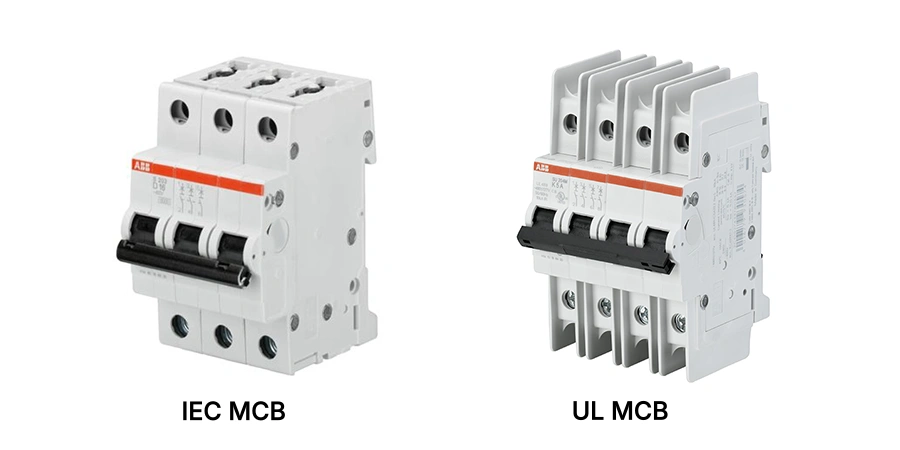
That’s a useful gut check for a buyer too. It’s not a replacement for verifying certification, but it can be a fast first filter.
If a supplier tells you a breaker is UL listed and it’s shaped like the IEC product you’ve bought from other factories in the same region, that’s worth a second look before you place the order.
You should verify the UL listing, file number, and whether the specific model and configuration are actually covered rather than relying on appearance alone.
None of this means one design is better built than the other. It just means the two standards are designed around different panel conventions, terminal types, and technician expectations.
A breaker made for one market doesn’t always drop neatly into a panel built for the other, even before certification requirements enter the picture.
| What to compare | IEC / CE-CB breaker | UL breaker |
|---|---|---|
| Typical width per pole | Often narrower, DIN-rail standard | Often wider, US panel standard |
| Terminal style | Often screw or cage-clamp, DIN style | Often different lug or box-lug style |
| Common mounting | 35 mm DIN rail | Panelboard-specific mounting |
| Governing standard | IEC 60947-2 | UL 489 |
Practical Advice If You’re Still Buying From China
None of this means you should walk away from a Chinese supplier — it means you should walk in with the right questions and a clear sense of where your project sits.
Start by being upfront about where the breaker is actually going to be installed, not just where your company is based. A US-based buyer sourcing for a project in Europe or the Middle East doesn’t need UL 489 at all, and a supplier who understands that will save you from paying for a certificate you never needed.
If your installation genuinely sits in North America and needs to pass inspection, ask directly whether the factory holds UL 489 for the specific product line you want, not just for the company as a whole, since certification is often granted per category rather than as a blanket approval.
Expect that a genuinely UL-listed Chinese factory will be able to hand over a file number you can look up yourself, and be cautious of any supplier who is vague about it or offers to “arrange” a certificate after the order.
If the project is outside North America, or it’s a smaller-scale or non-commercial application, ask about IEC 60947-2 test reports and CE documentation instead, and treat SAA the same way if Australia or New Zealand is the destination.
A supplier who is honest about which markets their certification actually covers, and which ones it doesn’t, is usually more reliable long-term than one who tells you what you want to hear just to close the order.
Getting this part right upfront saves both sides a lot of trouble later — a rejected panel, a stuck inspection, or a shipment that technically cleared customs but can never legally go into the wall it was bought for.
Final Thoughts
For buyers, the most useful question is often not “Does this supplier have UL?” but “What does my project actually require?” That small shift can make supplier comparisons much clearer.
It helps separate genuine compliance needs from assumptions, while giving you a more practical basis for evaluating products, costs, and the risks attached to each sourcing option.