
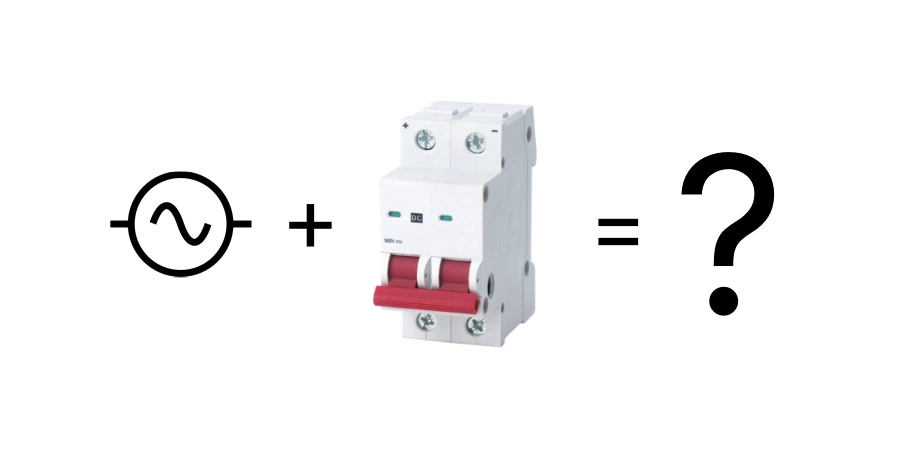
I recently came across a discussion about whether a DC circuit breaker can be used in an AC circuit, and I found it quite interesting.
We usually think about it the other way around. DC is harder to interrupt because it has no natural zero crossing, while AC passes through zero every half cycle. So DC circuit breakers often need stronger arc-extinguishing designs. If DC is the more demanding condition, shouldn’t a DC circuit breaker actually have an easier time in an AC circuit?
That logic sounds reasonable. But is it really that simple? Let’s look at the question from the opposite perspective.
The Key Difference Is in Fault Conditions
When you compare a DC circuit breaker with an AC circuit breaker, they may look pretty similar. Both can be DIN rail mounted, have similar dimensions, and may even have the same rated current.
But a similar face does not mean they can be replaced for each other. Their internal construction, arc-extinguishing methods, and breaking characteristics are designed for different types of current.
An AC circuit breaker can take advantage of the characteristics of AC current to help extinguish the arc, while a DC circuit breaker relies on specific arc-extinguishing structures and magnetic blowout to control the arc. So even if the two breakers appear to perform similarly during normal operation, their behavior under fault conditions can be very different.
Where Is the Problem?
If a DC circuit breaker is installed in an AC circuit, it may work normally under regular load conditions, and even overload protection may appear to operate correctly.
In fact, you can find examples of people saying that they have used a DC MCB on an AC supply without any problems. Here is one comment I came across on YouTube:

The real problem often occurs during a short circuit.
When a short circuit occurs, the breaker must safely interrupt a large fault current within a very short time. This is where the arc-extinguishing structure and breaking capacity become critical. A breaker designed and tested for DC applications does not automatically mean that it has been verified for AC fault conditions.
So, “works normally” does not mean “can safely interrupt the fault current.” you should not use it for another type of current simply because it can be physically installed or appears to work under normal conditions.
What Do the Rated Parameters Really Mean?
This is why choosing a circuit breaker requires more than checking its appearance or rated current. You also need to look at the complete ratings shown on the product label.
For example, if a breaker is marked “250V DC,” this means its rated performance has been verified under the specified DC conditions.
It does not necessarily mean that the breaker will immediately fail in an AC circuit. It means that you should not assume it has verified AC breaking capability.
International certification systems such as IEC, UL, and SAA require testing under specific application conditions, including rated voltage, fault current, and breaking capacity. Passing a DC test does not mean the breaker is suitable for AC applications.
What Do Major Manufacturers Say?
So, what do major circuit breaker manufacturers say about this issue? Let’s look at a real example.
Schneider Electric gives a clear answer in its official documentation. When asked whether a ComPact NSX DC circuit breaker can be used in an AC network, Schneider Electric does not recommend it.
The company explains that DC and AC circuit breakers can have differences in their contacts, insulation, and arc chambers. More importantly, the DC breaker has not been tested and certified for use in an AC network, so its performance in that application cannot be declared.
Source: Schneider Electric – Can a ComPact NSX DC breaker be used in an AC network?
This is an important point. The question is not simply whether a DC breaker can physically interrupt AC current. What matters is whether the specific breaker has been tested, rated, and approved by the manufacturer for use in an AC application.
In other words, even if the electrical principle may seem to suggest that a DC breaker should have no problem with AC, the manufacturer’s ratings and certification still need to be taken into account.
DC Only or AC and DC?
At the same time, this does not mean that a circuit breaker can never be used for AC and DC at the same time. Schneider Electric has products that are specifically rated for both types of current.
For example, its official information about the C60H DC and iC60 series states that the C60H DC MCB is designed for DC networks and cannot be used in AC networks, while the iC60H, iC60L, and iC60N ranges can be used in both AC and DC networks, with different breaking capacities depending on the application. (Source: Schneider Electric – Main difference between iC60 and C60H DC MCBs)
Eaton provides another example. Its C Series circuit breakers are described as being suitable for both AC and DC applications, with separate AC and DC ratings specified in the product documentation. (Source: Eaton C Series – Circuit Breakers for AC and DC Applications)
CHINT also offers similar products, as shown below:
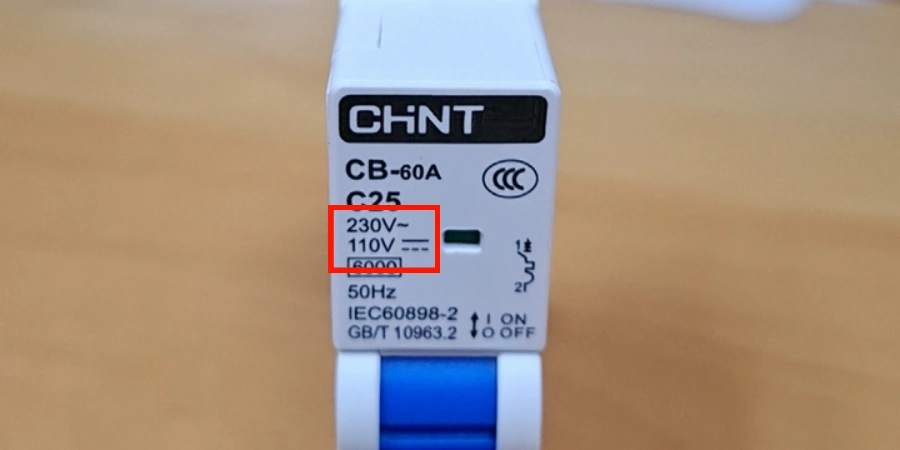
These examples show that the answer is not simply “yes” or “no.” A DC-only breaker should not be assumed to be suitable for AC. What matters is whether the specific product has been designed, tested, and rated for the intended application.
A DC breaker may appear to work normally on an AC supply, but that does not prove it can safely interrupt an AC fault. You should always check the manufacturer’s ratings and technical documentation before buying.
Final Thoughts
In the end, a circuit breaker should always be used within the conditions it was designed and tested for. What matters is not just how it looks or whether it works under normal conditions, but whether it is suitable for the application.