
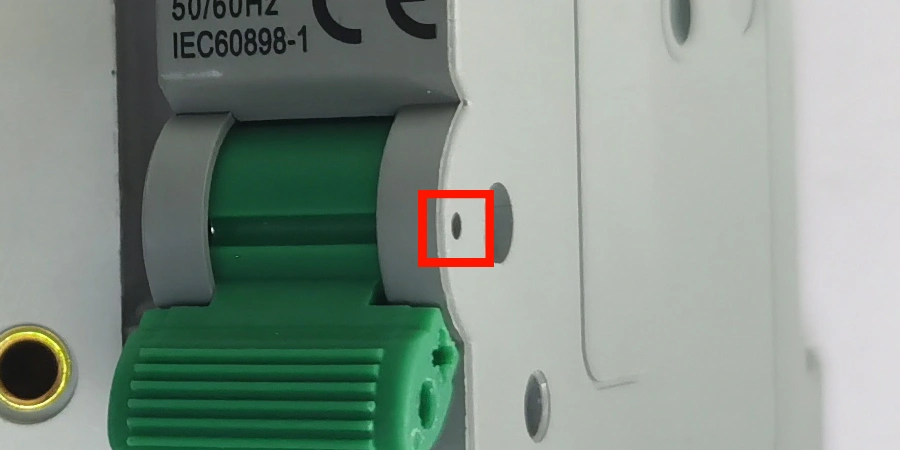
If you take a closer look at the handle of an MCB, you may notice a small hole near it. It looks like a minor detail and is easy to overlook. But have you ever wondered why this hole is there?
If you often work with distribution boards, control panels, or other electrical equipment, you may have seen this design many times. We usually operate the breaker without giving much thought to this small hole or what purpose it serves.
This simple detail is actually related to how electrical equipment is handled during maintenance and service. To understand why it matters, let’s start with something familiar: switching the breaker to OFF.
Why “OFF” Doesn’t Always Mean Safe?
Turning a circuit breaker to OFF only means that the breaker is currently switched off. It does not mean the equipment has been safely isolated.
For example, a maintenance technician may switch off a breaker before working on a machine. If the breaker is not locked or tagged, another person who is unaware of the work may reset it and restore power. The real safety concern is therefore not simply whether the breaker is OFF, but whether it can be turned back on without authorization.
This is the purpose of Lockout/Tagout (LOTO). Here I’ll use my breaker to give you a rough demonstration.
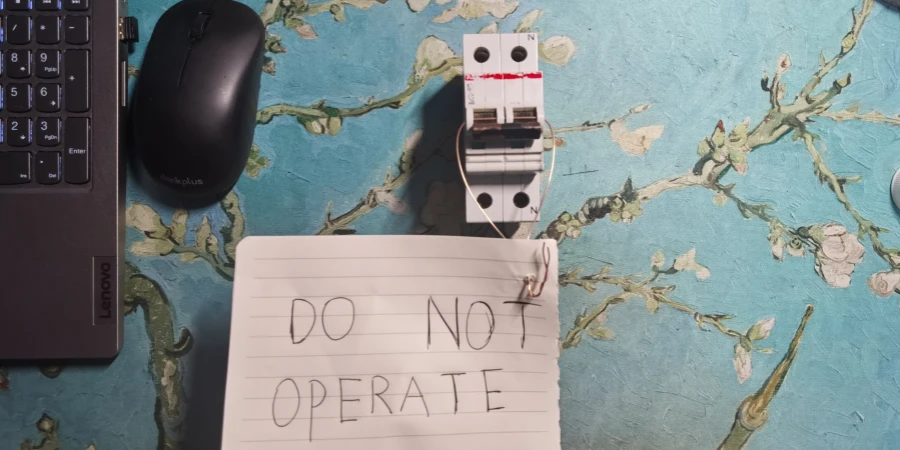
LOTO goes beyond switching a breaker off. By locking and tagging the energy-isolating device, it helps prevent the energy source from being reactivated during maintenance and identifies who is performing the work.
In simple terms: OFF means “it is switched off now.” LOTO means “it cannot be switched back on until the work is complete.”
The difference may seem small, but it is important when people are working on energized equipment or hazardous energy sources.
Not Just a Breaker Problem
This principle is not limited to circuit breakers. Valves, switches, motor disconnects — anything that controls stored or flowing energy can need the same treatment.
Breakers just tend to be the most common and visible example, since almost every electrical job touches one at some point. If you work with any kind of industrial equipment, the same logic applies well beyond the panel board.
| Situation | What “OFF” Tells You | What LOTO Adds |
|---|---|---|
| Breaker switched off, no lock | Handle is in OFF position | Nothing prevents someone else from switching it back on |
| Breaker locked, no tag | Handle is physically restrained | Restrains operation, but others don’t know why or by whom |
| Breaker locked and tagged | Handle is physically restrained | Restrained, identified, and traceable to the person doing the work |
What Lockout/Tagout Actually Does on a Breaker?
Once you separate “OFF” from “safe,” the role of LOTO becomes much clearer.
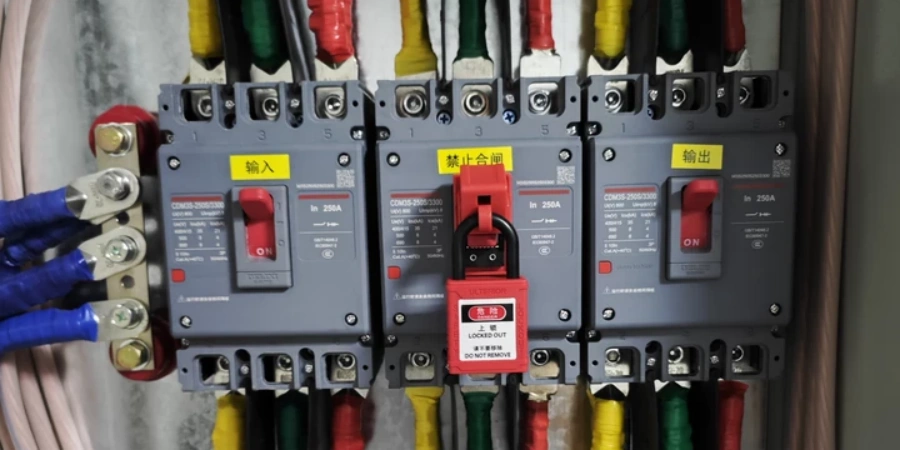
LOTO combines two functions: the lock prevents the breaker from being operated, while the tag explains why it is locked and who is working on it.
The lock physically holds the breaker handle in the OFF position, preventing anyone from switching it back to ON until the lock is removed. It creates a physical barrier against re-energization.
The tag provides information that the lock cannot. It can show who applied the lock, when it was applied, and why the equipment should stay off. In practice, some people may use a lock without a tag. However, using both makes it easier for others to understand who is working on the equipment and why it should not be turned back on.
A tag alone is only a warning, which is why the lock and tag are often used together.
Why Both Matter More in Bigger Teams?
In a small team, everyone may know what is happening, so relying on communication may seem enough.
As more people gain access to the same equipment, that becomes less reliable. Someone may not know that maintenance is in progress, and a simple misunderstanding can lead to an accident or equipment damage. This is when a more reliable form of protection is needed.
LOTO Is More Than Preventing Re-Energization
Many people underestimate the role of LOTO because the real risks are not always obvious.
As we mentioned, the most direct risk is someone turning the breaker back on while you are working inside the panel. Unexpected energization can lead to electric shock, arc flash, or burns. Fuji Electric also points out that unexpected re-energization can turn routine maintenance into a serious safety incident.
But that is not the only risk.
In more complex systems, the danger may come from other energy sources that are easy to overlook. Generators, solar systems, battery storage, or multiple power feeds can create more than one path to the same circuit.
Simply switching off and locking one breaker does not always mean the equipment is fully isolated. The Lawrence Berkeley National Lab safety manual points out that a complete LOTO procedure must identify all energy sources that could supply the equipment.
There can also be stored energy even after the power has been disconnected. For example, capacitors may still hold an electrical charge after a breaker is opened. Confirming that the equipment is actually in a zero-energy state, and releasing stored energy when necessary, is therefore another important part of the LOTO process. Tractian also identifies this as an important step in LOTO.
So, LOTO is not only about preventing someone from turning a breaker back on. It is about making sure that all energy sources have been identified and isolated before maintenance begins, and that the equipment cannot become energized unexpectedly during the work.
A small lock may not look like much, but when something goes wrong, it can make a real difference.
Where Else Does LOTO Apply?
It is worth remembering that LOTO is not only for major scheduled maintenance. Whenever a task involves a risk of unexpected energization, startup, or re-energization, LOTO may be needed.
Electricians and technicians may use LOTO when working on panels, feeders, or branch circuits, servicing motors or equipment supplied by those breakers, or carrying out tests, troubleshooting, or modifications that require the circuit to remain de-energized. Elec-Mate’s guide for electricians also covers these common situations.
| Task Type | Why LOTO May Be Needed |
|---|---|
| Replacing a breaker | People may be exposed to live electrical parts |
| Servicing a motor | Prevents the motor from starting unexpectedly |
| Testing or troubleshooting | Helps keep the circuit from being turned on unexpectedly |
| Visual inspection with the panel closed | May not involve contact with live parts |
One point is easy to overlook: whether LOTO is needed does not depend on how big the job is.
Replacing a breaker may take only a few minutes, but if the panel needs to be opened and energized parts may be exposed, the short duration does not make LOTO unnecessary. On the other hand, a simple external visual inspection with the panel closed usually does not require a full LOTO procedure if there is no exposure to energized parts.
The real question is whether the work involves a risk of unexpected energization, startup, or exposure to hazardous energy—not whether it is a “small” or “large” job.
Once LOTO is required, the procedure should also be followed consistently. A task may be simple, familiar, or only take a few minutes, but that is not a reason to skip the steps. The effectiveness of LOTO depends on applying the same basic precautions every time.
Final Thoughts
Good electrical safety often comes down to small details that are easy to overlook. LOTO is one of them.
The equipment, the lock, the tag, and the people working around them all need to fit into the same safety process. Once that becomes part of normal work, it becomes much easier to avoid preventable mistakes.