
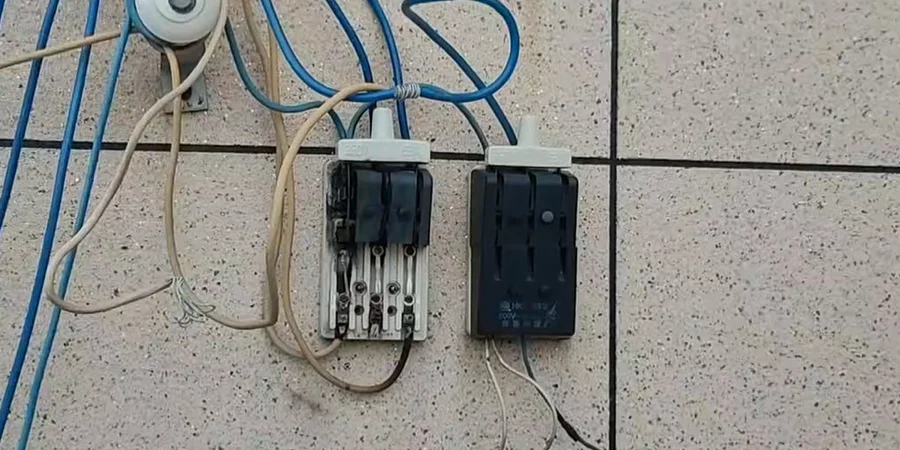
I don’t know if you ever saw one of these old knife switches in a house. If you grew up around older homes, you may still remember the simple metal blade and the distinctive way it was operated.
I still remember seeing my grandfather replace the fuse on one of these switches when I was a child. Back then, this was nothing unusual. It was simply how many households managed their electricity.
Today, however, old knife switches have become rare in residential homes. In their place, circuit breakers have become the standard choice for modern household electrical systems. So why did knife switches gradually disappear?
Why Were Knife Switches So Common in the Past?
Thirty or forty years ago, knife switches were a very common type of electrical component. Many households used them, and we would look at them as an earlier form of modern circuit breakers.
Back then, people’s living conditions were much simpler than they are today. There were not many electrical appliances in the home, and the need for electricity was not as high as it is now. For a normal household, a simple and cheap set of switchgear was enough to meet basic electricity needs.
The structure of a knife switch is also very simple. It connects or disconnects a circuit mainly through the contact or separation of a blade and a contact point, and it often has a fuse on it to provide basic short-circuit protection. Although its function is not complex, for the household electricity environment at that time, it was already practical enough.
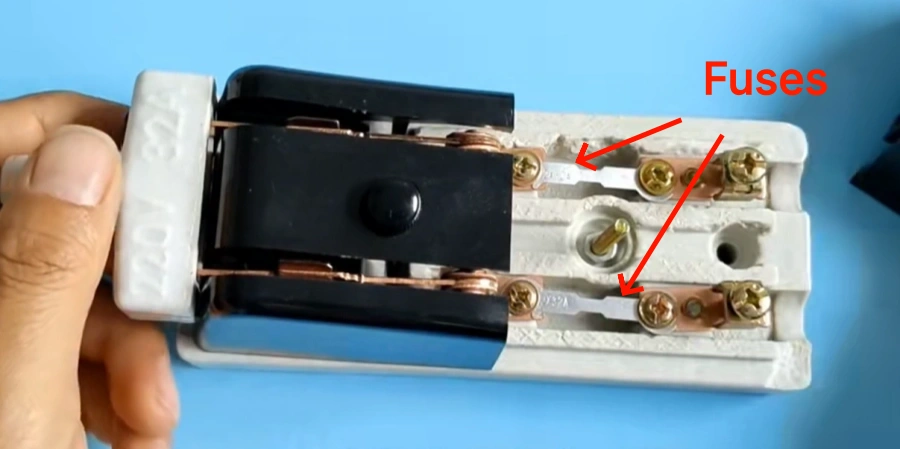
Moreover, the working state of a knife switch is very intuitive. When the blade touches the contact, the circuit is connected; when it is pulled away, the circuit is disconnected. The whole operation process can be seen directly, and it does not require complex operation or extra control methods.
With the rise of modern housing and the improvement of living standards, households have more and more electrical appliances, and the electrical load keeps increasing. People have also raised higher requirements for the safety and protection capability of electrical equipment. It is precisely under such changes that some of the limitations of knife switches have become increasingly obvious.
Why the Knife Switch Was Left Behind?
The real problem with knife switches is not that they cannot work properly — in the right places, they can still perform their original function. The real problem is that household electricity demands grew faster than knife switches could keep up with.
When a knife switch is manually opened while current is flowing, the blade and the contact gradually separate, producing an electric arc between them. When the current is small, this kind of arc is usually fairly small and extinguishes quickly. But when the current is large, especially during a fault or short circuit, the arc may persist and keep growing, creating a very serious danger.
The problems caused by the arc are not just burns. In some older homes, the building structure may use a large amount of wood, or there may be flammable materials near the switch. In such cases, the arc can easily cause a fire. Moreover, the knife switch itself does not have strong protective functions. If a short circuit occurs while the knife switch is closed, the only thing that can often prevent the accident from expanding further is the fuse on it.
Another important problem is the lack of overload protection. A knife switch is essentially just a manual disconnecting device. It has no detection mechanism and no automatic tripping function, so it cannot respond automatically when a dangerous situation happens. If the wiring starts to overheat because of an overload, the knife switch will still remain closed, allowing current to continue flowing until some component in the circuit burns out, or even causing a fire.
Operational problems
As modern household electrical systems have become more and more complex, relying purely on manual operation has gradually become a burden.
In a modern home, there may be twenty or thirty separate circuits, supplying power to different rooms and appliances. If each circuit used a separate knife switch for control, not only would it be very troublesome to manage, but it would also create safety problems. The home might need to have a large number of exposed blades installed, and every operation would mean the user facing a certain risk of electric shock.
Knife switches also have a problem with consistency of operation. Because they rely entirely on manual operation, the speed and force with which the switch is opened will differ from one operator to another. If it is opened relatively slowly or hesitantly, the arc may last longer, increasing the risk of damage.
How Did Safety Standards Push Knife Switches Out?
As electrical accidents such as electric shocks, burns, and fires continued to happen, governments and industry organizations gradually began to build various safety standards. These standards did not form overnight, but developed over decades through usage experience, lessons from accidents, and technological progress.
One understanding that formed quite early was that electrical equipment should prevent users from directly touching live parts. Today, this has become a basic principle in electrical safety, and this requirement has made open-type knife switches increasingly difficult to adapt to modern electrical systems. If live terminals are directly exposed, such equipment can hardly meet this basic safety requirement.
Standards organizations including the IEC, as well as relevant agencies in various countries, began to require residential electrical equipment to adopt enclosed structures and insulated designs to reduce the risk of accidental contact with live parts. These requirements were gradually incorporated into building codes, meaning that new homes and electrical renovations increasingly had to meet higher safety requirements.
Knife switches use a relatively open structure, so it became increasingly difficult for them to meet these requirements.
Certification and compliance
Modern circuit breakers need to meet a range of safety and performance requirements, including short-circuit breaking capacity, temperature rise, insulation performance, and mechanical and electrical life. Their performance must be tested to ensure they can operate safely under different conditions.
A basic knife switch was simply not designed around these requirements. It has no automatic tripping mechanism, limited arc-control capability, and an open structure that makes it difficult to prevent accidental contact with live parts.
As electrical codes continued to develop, the use of open-type knife switches in residential environments was gradually restricted in some countries and regions. In China, for example, old-style knife switches are no longer suitable for new homes, and in some rural areas where they still exist, they are gradually being phased out.
This change in standards and regulations created a clear dividing line: some old devices could still work properly, but were no longer considered suitable for continued installation in new buildings. Newer electrical devices, on the other hand, were designed from the beginning to meet modern safety requirements.
Knife switches eventually fell on the former side.
Why Circuit Breakers Became the New Normal?
Circuit breakers solved several problems at once. They combine switching, protection, and safety functions in a single device. In the past, fuses, switches, and protective devices might have been needed separately, but a circuit breaker can perform all of these functions at the same time.
One important change is that circuit breakers can respond automatically to faults. Unlike knife switches, which require manual operation to disconnect, circuit breakers act automatically based on the current conditions in the circuit. When an overload or short circuit occurs, the circuit breaker can automatically cut off the circuit without the user needing to notice the problem in time and operate it manually. This is very important for household electrical safety.
At the same time, circuit breakers also solve some of the operational problems of knife switches. The protective components of a modern circuit breaker are installed inside an enclosed housing. Users only need to operate it through an external handle and do not need to directly touch exposed live parts. After tripping, it can be switched back on once the fault has been cleared, without needing to replace a new component like a fuse.
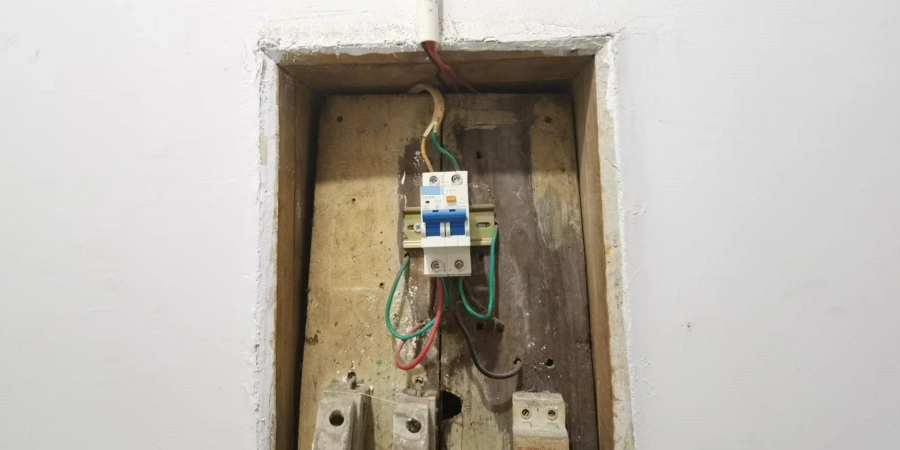
In fact, this change has already reached my own family. The old knife switch at my grandfather’s house was replaced last year with an RCBO, as shown in the picture below.
Better suited to modern household electrical systems
As the number of electrical circuits in homes increases, electrical systems also need to be managed more conveniently. A modern distribution box can house multiple breakers together, with each circuit breaker corresponding to an independent circuit.
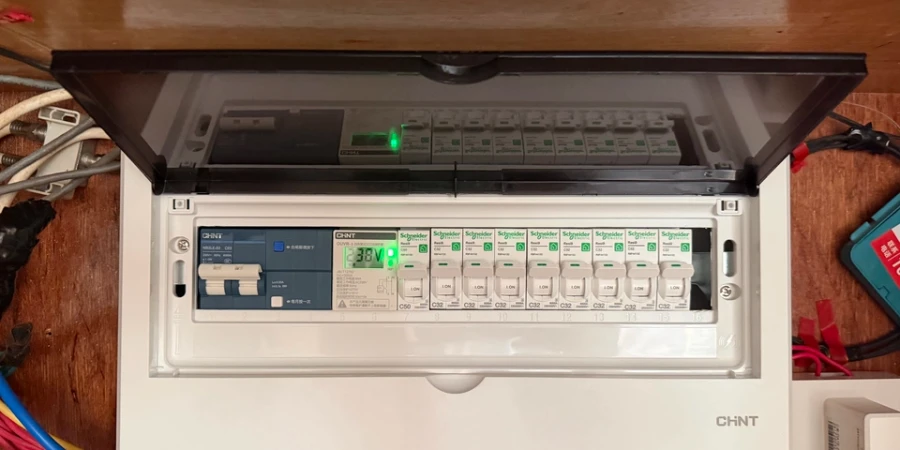
In this way, when a fault occurs in a certain circuit, the corresponding circuit breaker can be found quickly. When a new circuit needs to be added, the corresponding circuit breaker can simply be added as well. Different circuits can also use protective devices of different specifications according to actual needs.
This modular design makes circuit breakers not only safer than traditional knife switches, but also better suited to the increasingly complex electrical systems in modern homes. (Related Reading: Why Do MCBs Have a Standard Module Width?)
From this perspective, circuit breakers did not simply replace knife switches. Rather, as household electricity needs changed, they solved multiple problems at the same time, including protection, safety, and electrical system management. It is precisely because of this that circuit breakers gradually became the standard equipment in modern household distribution systems.
What Became of Knife Switches?
The history of knife switches shows that an electrical device can remain functional while gradually becoming unsuitable for a particular environment. Knife switches were not necessarily “bad” technology. They worked well enough for the electrical systems of their time, but modern homes eventually required better protection, safer operation, and more reliable fault protection.
This is also why knife switches have not completely disappeared. They can still be useful in some specific applications where their simple and visible switching mechanism is an advantage.
Where knife switches are still used?
Interestingly, knife switches have not completely disappeared. In some cases, they still have value:
- Teaching demonstrations: In physics labs and classrooms, knife switches are very suitable for teaching, because students can directly see the action process of the switch. The visible contact gap, the mechanical action, and the simple structure all make it a very good teaching tool.
- Low-voltage DC systems: In battery systems, automotive applications, or renewable energy systems, knife switches can provide reliable disconnection with an intuitive status. When the current is relatively small and the system uses direct current, the risk of arcing is also much lower.
- Industrial isolation applications: Some industrial systems still use enclosed knife switches as isolation switches. Internally, they still use a blade-and-contact structure, but the entire mechanism is installed inside a protective enclosure, and it is usually operated only when the circuit has already been de-energized.
- Special high-current applications: In some high-current systems, heavy-duty knife switches can provide simple and reliable disconnection. Such products are usually designed for specific applications and equipped with safety measures such as interlocks and arc protection devices.
In these applications, knife switches are usually used together with corresponding safety measures, operator training, and protective devices. They are different from the way they were used in residential environments.
Final Thoughts
After many years in this industry, this is the trend I have felt: electrical protection equipment has always been moving in the direction of being safer, more reliable, and more automated.
Technology also keeps advancing. Modern circuit breakers have begun to include features such as adjustable trip settings, remote monitoring, communication capabilities, and integration with smart home systems. Future electrical systems will not only be able to provide protection when a fault occurs, but can also provide real-time data, detect potential problems before a fault happens, and help optimize energy use.
But no matter how technology develops, one basic principle has never changed: people should not be exposed to unnecessary electrical hazards.
It is this principle, rather than any specific technology, that drove knife switches out of residential environments, and it will continue to shape the direction of future electrical protection technology.