
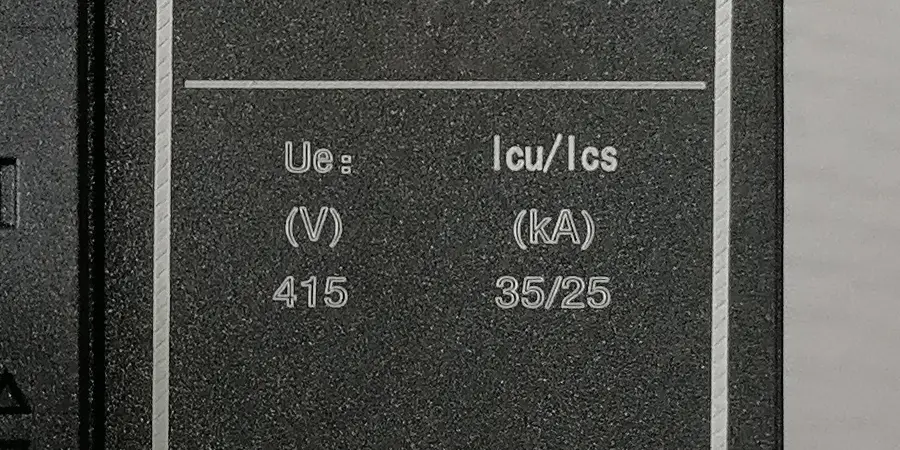
When buying a circuit breaker, we always pay attention to its breaking capacity. It tells us how much short-circuit current the breaker can safely interrupt. But did you know that the same circuit breaker can have different breaking capacities at different voltages?
Why does this happen? When comparing circuit breakers, it is easy to focus on the kA rating and overlook the voltage it applies to. However, a breaking capacity that looks high enough may not be suitable for every application.
So, how does voltage affect the breaking capacity of a circuit breaker? Understanding this relationship can help you compare product ratings more accurately and make better decisions when selecting a circuit breaker.
Why Does a Circuit Breaker’s Breaking Capacity Change with Voltage?
For the same circuit breaker, the breaking capacity can be different at different voltages. The key is that when a circuit breaker interrupts a short-circuit current, it must do two things. It must open its contacts—and it must extinguish the arc between them.
When a short circuit occurs, the moving and fixed contacts of the circuit breaker separate, and a high-temperature arc appears between them. The circuit breaker must extinguish the arc quickly to safely interrupt the fault current. If the arc is not extinguished—or if it restrikes after the contacts open—the breaker may fail to clear the fault.
The higher the voltage, the harder it usually is for the circuit breaker to complete this process. After the contacts open, voltage still exists across them. The higher the voltage, the stronger the electrical stress. That places greater demands on insulation recovery and arc extinction. If the breaker cannot handle it, the arc may persist or restrike.
Therefore, the same circuit breaker may have different breaking capacities at different voltages. This is also why a circuit breaker’s breaking capacity must be stated together with its rated voltage, rather than looking only at the kA value.
Why is the arc-extinguishing structure important?
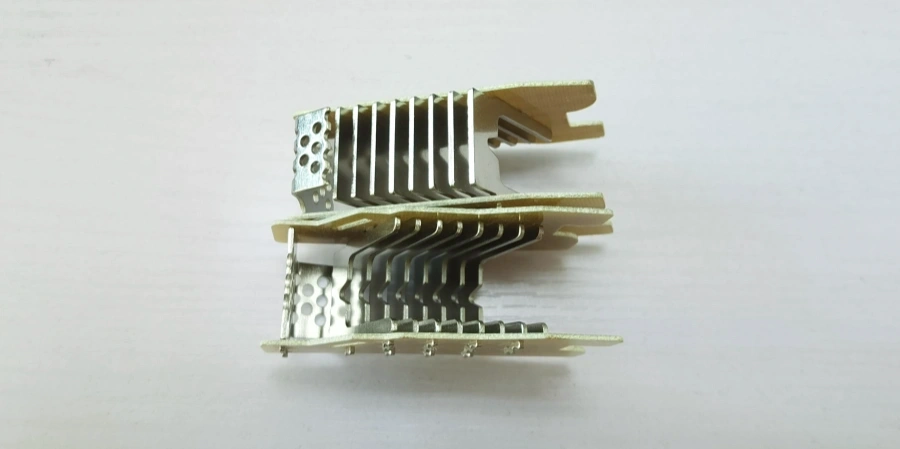
To help extinguish the arc quickly, circuit breakers usually have dedicated arc-extinguishing structures. For example, a common arc chute is made of multiple metal plates. It can split the arc into shorter arc segments and help cool the arc, thereby promoting arc extinction.
Different circuit breakers have different contacts, arc-guiding structures, and arc chamber designs, so the current they can safely interrupt may also differ. When the operating voltage increases, the arc-extinguishing system must handle greater electrical stress, and the circuit breaker’s breaking capacity may decrease accordingly.
Real example: schneider electric compact NSX400N
Let’s take a look at a real example, the Schneider Electric Compact NSX400N mccb. According to its official product datasheet, model LV432693 has the following rated ultimate short-circuit breaking capacity (Icu) at different AC voltages:
| Rated Voltage | Icu (Rated Ultimate Short-Circuit Breaking Capacity) |
|---|---|
| 220/240 V AC | 85 kA |
| 380/415 V AC | 50 kA |
| 440 V AC | 42 kA |
| 500 V AC | 30 kA |
| 660/690 V AC | 10 kA |
We can see this circuit breaker at 220/240 V AC, this breaker has an Icu of 85 kA. At 660/690 V AC, it drops to just 10 kA. The trend is clear: as voltage rises, breaking capacity falls.
This example shows something important. A circuit breaker’s breaking capacity is not a fixed value. It changes with voltage.
That said, not every circuit breaker will show the same amount of change. Some may drop sharply as voltage rises. Others may drop only slightly.
The actual ratings depend on the specific product design. They also depend on the manufacturer’s test data. So always use the data for the exact model you are considering.
What Does This Mean for Circuit Breaker Selection?
Suppose a project uses a 400 V three-phase system. The calculated prospective short-circuit current is 20 kA. In this case, you should choose a circuit breaker whose breaking capacity at 400 V is at least 20 kA.
Now suppose the same design is used in a 690 V system. You must recheck the breaker’s rated breaking capacity at 690 V. Do not simply carry over the value from the 400 V case.
In practice, manufacturer data should be used as the basis, ensuring that the circuit breaker’s breaking capacity at the target operating voltage meets the system’s prospective short-circuit current requirement.
Why Is It Harder to Extinguish an Arc at Higher Voltage?
Earlier, we said that when a circuit breaker interrupts a short circuit, the hard part is not pulling the contacts apart. The hard part is putting out the arc.
So why is the arc harder to put out at higher voltage? The key idea is simple: an arc is a conductive path kept alive by an electric field.
When the contacts of a circuit breaker separate, the metal surfaces that were touching are pulled apart. But the current does not stop right away. Just before the contacts fully separate, the contact area becomes very small, so the current density rises sharply. The local temperature can reach thousands of degrees.
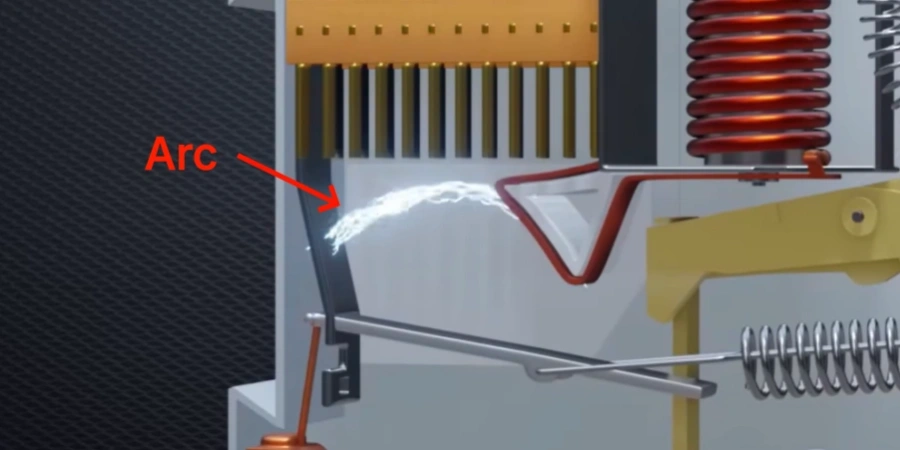
This heat ionizes the air or gas between the contacts and turns it into a plasma made of electrons and ions. As long as the electric field is strong enough, these charged particles keep moving, and current keeps flowing through the arc.
So the goal of arc extinction is to remove the conditions that keep this conductive path alive. Higher voltage makes this harder in several ways.
1. The electric field is stronger
After the contacts open, voltage still exists across the gap. The higher the voltage, the stronger the electric field across that gap. A stronger field accelerates charged particles more effectively. It also makes ionization easier to sustain.
Even if the breaker tries to cool and stretch the arc, the arc may rebuild itself. This can happen as long as the field is strong enough. This is called restriking.
2. The arc has more energy
If the short-circuit current is roughly the same, a higher voltage means higher arc power. Arc power is roughly arc voltage multiplied by current. More power means a hotter arc, and a hotter arc is harder to cool quickly.
Since one of the main goals of arc extinction is to cool the arc below the temperature needed to keep it ionized, higher voltage puts more heat stress on the arc-extinguishing system.
3. The gap must recover its insulation faster
After the contacts open, the gap between them must change from a conductive state back to an insulating state. This process is called dielectric recovery.
The arc can only be truly extinguished if the gap recovers its insulation faster than the voltage tries to break it down again. Higher voltage raises the demand on this recovery process. In other words, the same arc-extinguishing design may recover fast enough at low voltage but not at high voltage, so the arc may persist or restrike.
4. The arc-extinguishing structure has to work harder
To speed up arc extinction, circuit breakers often use an arc chute to split the arc into several shorter arcs. They may also use some methods to stretch and cool the arc.
These methods work well at low voltage. But at higher voltage, the arc can more easily jump across these barriers or reconnect after being split. As a result, the same arc-extinguishing system can safely interrupt less short-circuit current at a higher voltage.
Here is a simple, if not perfectly accurate, way to picture it: the arc is like a burning conductive path, and voltage is like the wind that keeps it burning. The stronger the wind, the harder it is to put the fire out. Even if the fire goes out for a moment, it can easily start again. The circuit breaker has to cut this conductive path completely and stop it from coming back, all within a very short time after the contacts separate.
One more point about AC and DC. AC voltage crosses zero twice in every cycle, so the current naturally pauses for a moment. The arc is easier to extinguish near these zero crossings. This gives AC circuit breakers a useful window for arc extinction. DC has no natural zero crossing, so once an arc forms, it is harder to stop by itself.
At the same voltage level, DC arc extinction is usually more difficult, and the effect of voltage on breaking capacity can be more obvious. But the basic rule is the same for both AC and DC: the higher the voltage, the harder it is to extinguish the arc. DC simply makes this challenge even greater.
Final Thoughts
Talking about a circuit breaker’s breaking capacity without considering voltage is meaningless. The same circuit breaker can have different breaking capacities at different voltages.
When choosing a breaker, always check its rated breaking capacity at the actual operating voltage. This is a small detail, but it can make a big difference in selecting the right product.