
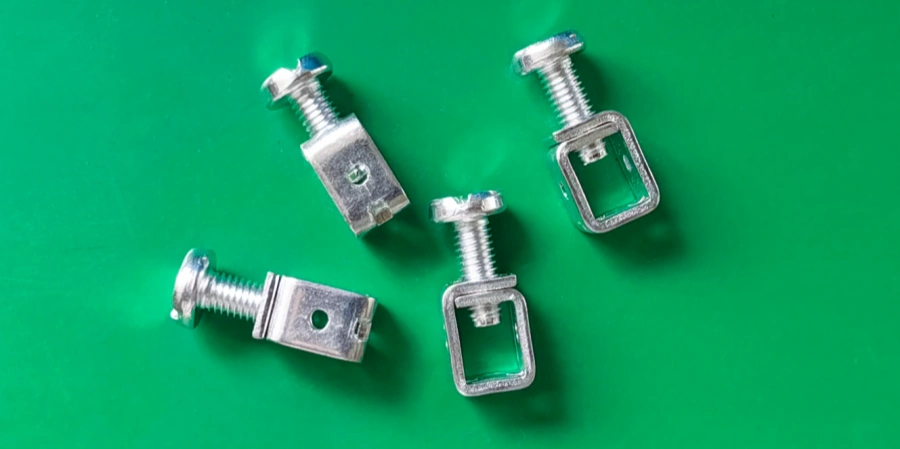
The terminals on circuit breakers are metal parts used to connect wires. They usually clamp the conductor in place with screws or other fastening structures, ensuring a reliable electrical connection between the wire and the component.
When designing a breaker, the material choice for the terminal needs to balance electrical performance, mechanical performance, and manufacturing cost. Different material properties also affect the design and application of the terminal.
So, what materials are terminals on breakers actually made of? Why are these materials used in terminal structures? Let’s take a look.
The Most Commonly Used Material for Terminals
Galvanized carbon steel is the most widely used material for breakers’ terminals. Contactors and isolators are no different — this material shows up everywhere in their structures.
Carbon steel has high hardness and mechanical strength, so it can withstand the tightening force applied during installation, making it well suited for fasteners. For example, terminal screws need to maintain a stable clamping state after tightening, so the material must have enough strength to meet the requirements of normal installation and use. Carbon steel meets the needs of many such parts and is also easy to machine and mass-produce.
However, steel is prone to corrosion in humid environments. For this reason, carbon steel is usually galvanized. The zinc coating protects the steel, slows corrosion, and helps improve the part’s corrosion resistance. The actual level of protection depends on factors such as coating quality, surface treatment process, and the operating environment.
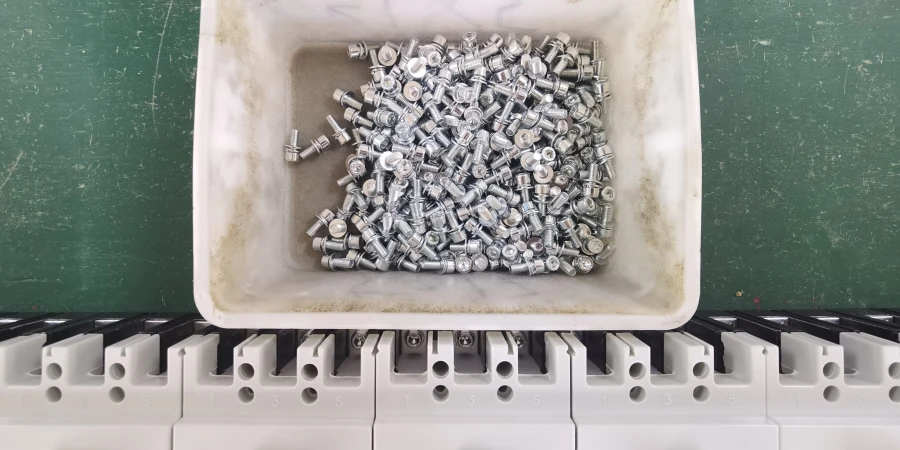
In addition to mechanical performance and corrosion resistance, cost is another important reason carbon steel is so widely used.
Compared with metals such as copper, carbon steel is cheaper, making it suitable for fastening parts that need to be produced in large quantities. Based on a rough estimate using recent market prices, electrolytic copper costs more than 30 times as much as ordinary steel.
You can use this link to check real-time prices of various raw metals in China: https://www.metal.com/
Of course, actual purchasing costs vary with material grade, form, and order quantity, but this is enough to show that for fasteners used in large volumes, material cost is one of the practical reasons carbon steel is preferred.
After galvanizing, it achieves a good balance between cost, mechanical strength, and surface protection, which is why it is a common choice for fastening parts in many electrical components.
What Other Materials Are Used for Terminals?
Besides galvanized carbon steel, terminals may also use materials such as copper, brass, and aluminum.
Different structural designs and application requirements mean the default terminal material can also be different. In addition, some metal parts receive surface plating treatments, such as nickel, silver, or tin plating, to meet specific product design requirements.
Let’s still take circuit breakers as an example.
Copper is used for the terminal parts of some circuit breakers. Copper has good electrical and thermal conductivity, making it suitable for carrying current. Some products also have silver or nickel plating on the copper terminals to improve contact performance and corrosion resistance.
Brass is also used in the terminals of circuit breakers and other electrical components. It has good machinability and is suitable for making connection parts in different shapes. Some products use surface treatments such as tin plating to meet specific design requirements.
Aluminum can also be used for the terminals of some circuit breakers. Aluminum’s advantages are its light weight and relatively low cost, but its surface easily forms an insulating oxide film, it is relatively soft, and there is a risk of galvanic corrosion when it comes into direct contact with copper. For this reason, aluminum terminals usually need surface treatment or a copper-aluminum transition structure to ensure a reliable connection.
Take MCCBs as an example: Mitsubishi Electric’s official FAQ clearly states that the 400A class uses aluminum alloy for the bar terminals, while 630A and above use copper. This shows that even within the same brand and the same product category, the default terminal material can change with the current rating.
Overall, the default terminal material is usually galvanized carbon steel. Copper, brass, and aluminum are also used, but less commonly. Some parts may also receive surface treatments such as nickel, silver, or tin plating. The actual material and treatment used should be determined based on the current rating, conductor material, and the specific product’s design requirements.
How Do Different Terminal Materials Affect Component Performance?
For most electrical components, like circuit breakers, the external conductors connect directly to the internal contact plates, so the terminal material has little effect on the components’ overall electrical conductivity. (check the image below).
In contrast, the effect of different materials on temperature rise is more worth attention, because the material’s resistance characteristics and thermal conductivity affect heat generation and heat dissipation during operation.
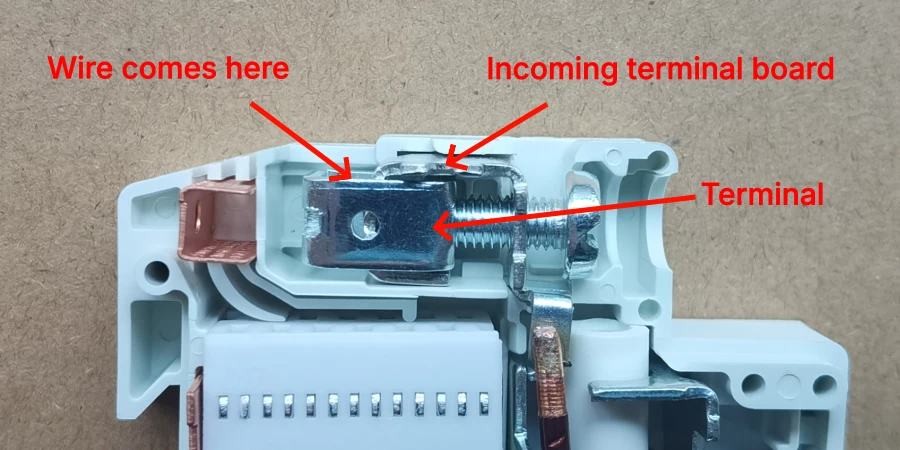
Different metals have different thermal conductivity and resistivity. For example, copper conducts heat well, while steel conducts heat relatively poorly. These differences in the material itself affect how the terminal generates and dissipates heat when carrying current. Therefore, when manufacturers choose terminal materials for components, in addition to mechanical strength, corrosion resistance, and cost, it is also necessary to consider its effect on temperature rise.
China’s national standard GB 14048.1-2012, Low-voltage switchgear and controlgear – Part 1: General rules, sets temperature rise limits for terminals made of different materials. These limits are listed in Table 2, “Temperature-rise limits for terminals,” as follows:
| Terminal material | Temperature rise limit (K) |
|---|---|
| Bare copper | 60 |
| Bare brass | 65 |
| Copper (or brass), tin-plated | 65 |
| Copper (or brass), silver- or nickel-plated | 70 |
| Other metals | Not exceeding 65* |
Note: The temperature rise limit for other metals is determined based on service experience or life tests. Product standards may specify different temperature rise values according to different test conditions and small electrical component requirements, and the relevant provisions in the original standard should be followed.
As the table shows, the national standard specifies corresponding temperature rise limits for different terminal materials and surface treatments. These values are the upper limits allowed by the standard and do not mean that the terminal’s actual temperature rise will necessarily reach these values.
Overall, the choice of terminal material is not only related to mechanical strength, corrosion resistance, and cost, but also to the product’s temperature rise requirements. Manufacturers need to consider material properties and the relevant standard requirements together, and choose a material suited to the product design and operating conditions.
Final Thoughts
Choosing a terminal material is essentially a balance between mechanical strength, corrosion resistance, temperature rise performance, and cost. There is no universal answer that works for every product. Understanding these trade-offs is more useful than memorizing which material is “better.”
For material selection, the real questions to answer are: What function does this part serve, what operating conditions is it exposed to, and which standard applies to it? Discussing material pros and cons apart from a specific product easily leads to one-sided conclusions. For actual material selection, the product’s technical documentation and the relevant standards should still be the reference.