
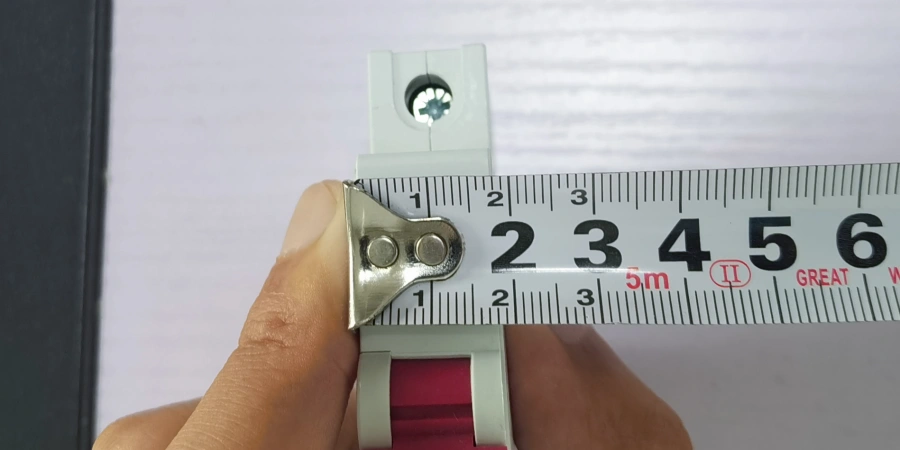
Have you ever noticed how similar the widths of those small breakers in a distribution board look? Even when MCBs have different current ratings and functions, their physical sizes are often quite similar.
If you look a little closer, you’ll see that this is not just a coincidence. MCBs are designed around a common size system, so different breakers can fit into the same type of installation.
This is where the idea of an MCB module comes in. A module is simply a way to describe the width of an MCB and how much space it takes up.
What Does Module Width Mean?
MCBs are not made in random widths. To make different breakers easier to install in the same type of distribution board, manufacturers use a module system to describe the space an MCB takes up.
Simply put, a module is a unit used to describe the width of an MCB. One module is usually about 18 mm wide. This is why you will often see terms such as 1 module, 2 modules, 3 modules, and so on.
For example, a 1-module MCB is usually about 18 mm wide, while a 2-module MCB is usually about 36 mm wide. In the same way, a 3-module MCB is usually about 54 mm wide.
For common MCBs, we can think of it quite simply: the more modules an MCB has, the more space it takes up on the DIN rail. This makes the module system a convenient way to estimate how much space different breakers will need in a distribution board.
However, not every MCB follows the simple rule of “one pole = one module.” The actual width can be different depending on the product design. Some higher-current or higher-breaking-capacity MCBs, for example, may need more space for their internal components, so a single-pole breaker may take up 1.5 modules or more instead of the standard 1 module.
This is why the module is best used as a general reference. When installing an MCB or designing a distribution board, you should still check the actual dimensions of the specific product.
MCB accessories can also take up additional space. Accessories such as auxiliary contacts and shunt trip devices are usually installed on the side of the breaker, so they should also be considered when planning the available space in a distribution board.
Why Is One Module Usually 18 mm?
As we mentioned, one module is usually about 18 mm wide. But why did 18 mm become such a common module size?
It was not a size chosen by one manufacturer alone. It developed as low-voltage electrical equipment became more standardized. For distribution board makers, installers, and electrical equipment suppliers, using similar module sizes makes it easier to install products in the same type of system, replace products, and plan installation space.
How Is 18 mm Related to DIN Rail Mounting?
To understand why MCBs use a modular size, it helps to look at how electrical equipment was installed in the past.
In the past, many low-voltage devices were mounted directly on wooden or other insulating boards. For example, knife switches and fuses were often installed this way. Later, as modern housing and apartment buildings became more common, distribution boards gradually moved to built-in designs.
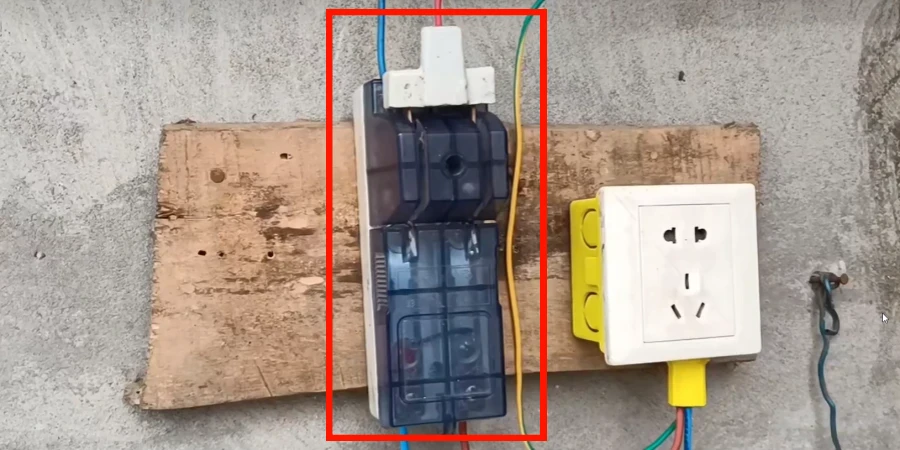
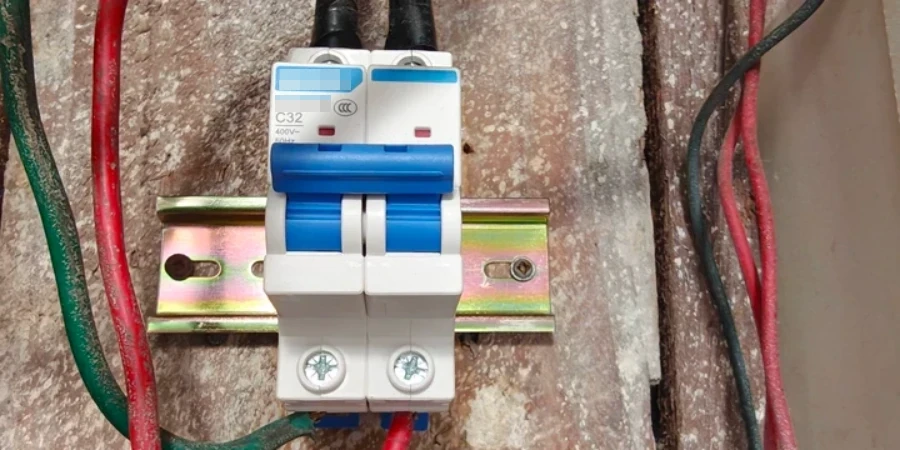
DIN rails were added inside the boards, allowing small breakers and protection devices to clip directly onto the rail. This made installation more organized and made replacement and expansion easier.
As this type of installation became more common, product sizes also needed to become more consistent. If every manufacturer made MCBs with completely different widths, it would be difficult to plan the space inside the same distribution board.
This led to the use of modular MCB widths. It allows MCBs with different numbers of poles and from different manufacturers to fit into the same type of installation system.
So, 18 mm was not suddenly “invented” by one manufacturer. It gradually became a common module size as DIN rail mounting, smaller product designs, and standardization of low-voltage electrical equipment developed.
Why Is 18 mm a Practical Size?
Standardization is not the only reason. The width of an MCB also needs to balance the space needed by its internal parts with the space available inside a distribution board.
Although an MCB looks small, it still needs to contain contacts, a bimetal strip, a trip mechanism, an arc chamber, and other parts. If the MCB is too narrow, there may not be enough room for these components. On the other hand, if it is too wide, fewer circuits can fit into the same distribution board, and the whole board may need to be larger.
You may also notice that 18 mm, 36 mm, and 54 mm are all multiples of 9 mm. Some people may wonder why the module size was not based on 10 mm instead. From a numerical point of view, 10 mm would certainly be easier to remember and calculate. But real products also need to consider manufacturing tolerances and assembly requirements.
This means the module size is not only about having a simple number. It also needs to work well in real manufacturing and installation. When several poles are combined, their overall width takes these small tolerances into account and tends to move toward a more regular overall size, closer to a whole multiple of 10 mm. This helps keep the product compact while still allowing smooth installation.
So, the MCB size needs to balance compact design, internal component space, and manufacturing tolerances. The 18 mm module provides a common reference, while the actual product is designed with reasonable tolerances so that both single-pole and multi-pole MCBs can be arranged and installed properly.
In other words, the module system not only helps manufacturers design and produce MCBs, but also helps installers quickly estimate how many MCBs can fit in a distribution board.
Why Is an MCB Not Always Exactly 18 mm When Measured?
Here is another question that may come up. If you use a vernier caliper to measure a single-pole MCB, you may find that its actual width is slightly less than 18 mm, such as 17.5 mm or 17.6 mm.

This is because 18 mm is mainly a reference size in the module system. It does not mean that every MCB must have an actual outside width of exactly 18.00 mm.
If every MCB were made to exactly the same theoretical size, the actual installation would still need to account for product dimensions, tolerances, and the combined effect of several products installed next to each other. Manufacturers therefore leave a certain amount of dimensional allowance in the product design. This helps several MCBs fit together smoothly without binding during installation or removal.
That is why an MCB can be slightly narrower than 18 mm and still be called a 1-module MCB. The small gaps between adjacent MCBs can also be useful, as they allow some airflow between the devices and can help with heat dissipation when several breakers are carrying higher loads at the same time.
What Does This Dimensional Allowance Mean for Production?
This dimensional allowance is also important in mass production. MCB housings are usually made by injection molding, while terminals, mounting clips, and other parts need to be assembled. Small differences in actual dimensions are therefore normal in production.
Even large MCB manufacturers producing tens or even hundreds of millions of breakers each year on highly automated production lines cannot make every unit exactly 18.00 mm wide. Automation can improve production consistency, but it cannot completely eliminate manufacturing tolerances from injection molding, stamping, and assembly.
More importantly, if every MCB were made exactly 18.00 mm, or even a little bigger than the theoretical size, the total width could grow when several MCBs are installed side by side. As the tolerances add up, the whole row could take up more space than planned, making it harder to install and line up.
From a practical point of view, there is also little benefit in controlling this tolerance too tightly. As long as the actual MCB dimensions stay within a reasonable design range, the products can be installed properly in the corresponding module space. Making every unit closer to exactly 18.00 mm would add production and inspection costs without much practical benefit.
Final Thoughts
MCB dimensions can look simple at first, but there is more behind them than just a few numbers. The module system is one small part of how electrical products are designed to work together in a limited space.
So, the next time you see an MCB described as 1 module, 2 modules, or 3 modules, you’ll have a better idea of what those numbers actually mean in practice.