
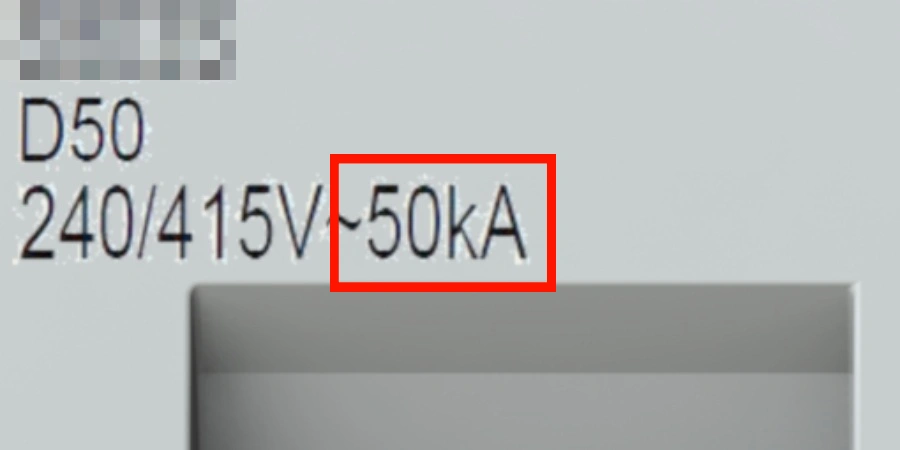
Once, while I was googling for some information, I came across an MCB with a 50kA breaking capacity. I was honestly surprised and wondered if there was a mistake in the product information. After all, 50kA is an extremely high breaking capacity for an MCB, reaching the level of some industrial MCCBs.
I checked again and confirmed that the specification was real. That raised a bigger question: Is such an ultra-high breaking capacity designed to meet real application needs, or is it mainly a way for major manufacturers to show their technical capabilities? If such a high breaking capacity is truly required, why not simply use a larger frame-size breaker?
After participating in different customer projects, I gradually came to understand that the selection of circuit breakers is influenced by many factors, not just breaking capacity alone.
Breaking Capacity and Rated Current: Two Different Design Parameters
When I first started in this industry, I assumed that the bigger the breaker, the higher its breaking capacity. It seemed logical—more material, more space, more capability. I suspect many people in this field have had the same assumption, at least at the beginning.
It took me a while to realize that this is not how it works. Breaking capacity and rated current are two separate design targets. Improving one does not automatically require increasing the other—and this design independence is what makes high-breaking-capacity breakers possible within the same frame size.
Rated current determines how much current a breaker can carry continuously under normal operating conditions. This mainly depends on thermal design, such as conductor size, heat dissipation capability, and thermal trip settings.
Breaking capacity, on the other hand, determines whether a breaker can safely interrupt a short-circuit current. It depends on completely different design factors, including the arc extinguishing system, arc control capability, contact separation speed, and mechanical strength.
This is why, in real applications, engineers cannot focus only on rated current. They also need to consider the prospective short-circuit current of the system and the required breaking capacity.
How Can Manufacturers Increase Breaking Capacity Without Increasing Size?
So, how can manufacturers achieve higher breaking capacity without simply increasing the product size? The key is to optimize the internal components responsible for fault interruption rather than redesigning the entire breaker structure.
High-breaking-capacity MCBs usually improve areas such as the arc extinguishing system, contact structure, and internal mechanical strength. For example, a more efficient arc extinguishing design helps the breaker cool and extinguish the arc faster; improved internal structures help control arc movement during short-circuit interruption; and enhanced contact mechanisms ensure reliable separation under high fault currents.
At the same time, the internal structure needs to be strong enough to withstand the high electromagnetic forces generated during short-circuit conditions. The result is that the core fault-interruption system inside the breaker becomes stronger, allowing it to withstand and interrupt higher levels of fault current.
Why Not Simply Move to a Larger Frame Size?
When many people first see an MCB with a 50kA breaking capacity, they may have the same question I had when I first came across one: Why not just use an MCCB?
From a purely electrical performance perspective, using an MCCB does seem like a straightforward solution. After all, MCCBs can provide higher breaking capacities and are specifically designed for applications with higher short-circuit levels.
So why are major manufacturers still investing large R&D resources into developing high-breaking-capacity MCBs? These products are more difficult to design, and their prices are usually much higher than standard MCBs, sometimes even exceeding those of some conventional MCCBs.
This means these products are not designed for ordinary applications. They are developed to solve specific engineering challenges.
Keeping the Existing MCB System
An MCB is not simply a smaller version of an MCCB. Although both are used for low-voltage circuit protection, they are usually applied in different types of systems.
The modular design, DIN rail mounting, and standardized accessories of MCBs make them common protection devices in control panels, industrial equipment, and distribution systems.
For many OEM manufacturers and system integrators, the entire electrical design of their equipment is built around the MCB platform from the beginning.
For example, an industrial control panel may contain dozens or even hundreds of MCBs, each protecting different control circuits, auxiliary circuits, and functional modules. The installation method, internal layout, wiring design, and maintenance procedures are all based on this modular system.
In such cases, replacing certain MCBs with MCCBs due to higher short-circuit levels is not always just a simple component replacement. It may affect the overall system design, including installation methods, cabinet structure, and manufacturing processes.
High-breaking-capacity MCBs provide another option: improving short-circuit protection at specific points while keeping the existing MCB-based system architecture unchanged.
Getting Higher Protection in Limited Space
Besides system compatibility, space utilization is another important reason for developing high-breaking-capacity MCBs.
In many applications, what needs to be improved is only the protection capability under short-circuit conditions, not the continuous operating current.
This means users do not necessarily need a larger frame size. One key advantage of high-performance MCBs is that they allow systems to maintain a DIN rail modular structure while achieving higher levels of short-circuit protection.
For example, some high-performance MCBs can provide up to 50kA of breaking capacity while still maintaining a compact modular design. The ABB S800 series, for example, has a single-pole width of around 27mm (around 1.5 modules), meaning that a 2-pole version is about 54mm wide—roughly the same width as a standard 3-pole MCB.
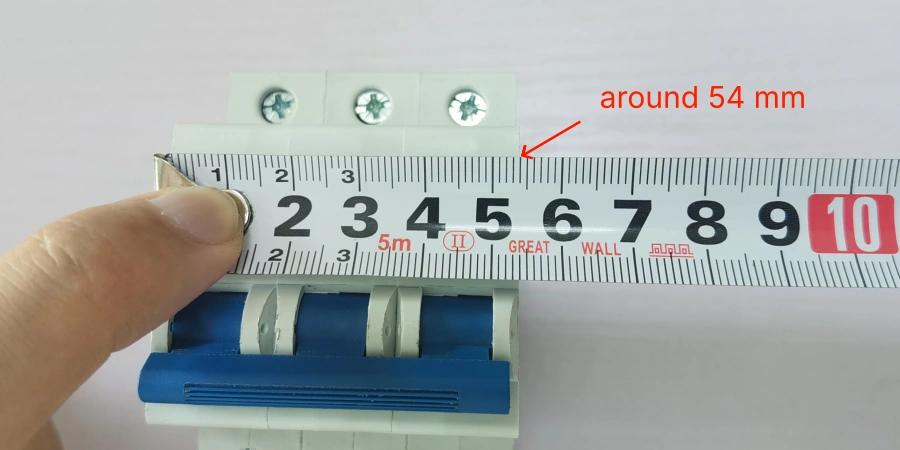
By comparison, typical 100A-class MCCBs usually use a separate frame design and require additional space for terminals, mounting accessories, and maintenance access.
Therefore, in control panels, automation equipment, and space-limited electrical systems, high-breaking-capacity MCBs allow designers to maintain the original modular layout without redesigning the entire installation due to increased short-circuit requirements.
Rising Short-Circuit Currents in Modern Electrical Systems
Another reason behind the development of high-breaking-capacity MCBs is the changing nature of modern electrical systems.
In the past, MCBs were mainly used in residential and standard commercial applications, where available short-circuit currents were usually relatively limited. However, with the growth of industrial automation, renewable energy systems, power electronics, and intelligent equipment, the application range of MCBs has expanded significantly.
Today, MCBs are increasingly used in industrial control panels, automation equipment, photovoltaic systems, energy storage systems, and other specialized electrical equipment.
Some of these devices are installed closer to power sources, such as transformers or main distribution systems. The closer the installation point is to the power source, the higher the potential short-circuit current can be.
In these situations, traditional 6kA or 10kA MCBs may no longer meet the protection requirements. However, the equipment itself may not require a higher continuous current rating. What users actually need is higher breaking capacity under fault conditions, not a larger current rating.
This is the key reason why high-breaking-capacity MCBs exist: they solve the need for higher short-circuit protection, rather than higher load current requirements.
Why Ultra-High Breaking Capacity Matters
An ultra-high-breaking-capacity MCB is not developed simply because manufacturers want to create a higher specification. It solves a practical engineering challenge—and the same design philosophy is not limited to MCBs.
A similar trend can also be seen in MCCB products. For example, some 100A-class MCCBs in Schneider Electric’s ComPacT NSX series can provide up to 100kA breaking capacity. ABB Tmax XT and Siemens SENTRON series also include high-breaking-capacity versions, with some models reaching 150kA Icu or higher.
These examples confirms what we saw earlier: frame size, rated current, and breaking capacity are not tied together. Through platform optimization, some MCCBs can already reach the common breaking capacity levels of many low-voltage ACB products.
From MCBs to MCCBs and ACBs, the same development trend is visible: manufacturers are increasingly optimizing different product platforms according to actual application requirements, allowing users to achieve more suitable protection performance within their existing system architecture instead of simply moving to a larger product category.
Final Thoughts
So a 50kA MCB simply reminds us that the key parameters of a circuit breaker do not always move together. Rated current, breaking capacity, and frame size each follow their own design logic, and each can be optimized separately for different situations.
Once you see that, a specification that looks “over the top” no longer comes across as surprising. Instead, it starts to make sense as a response to a real engineering need. Technical specs are never created out of thin air — they always point to something specific in the field.