
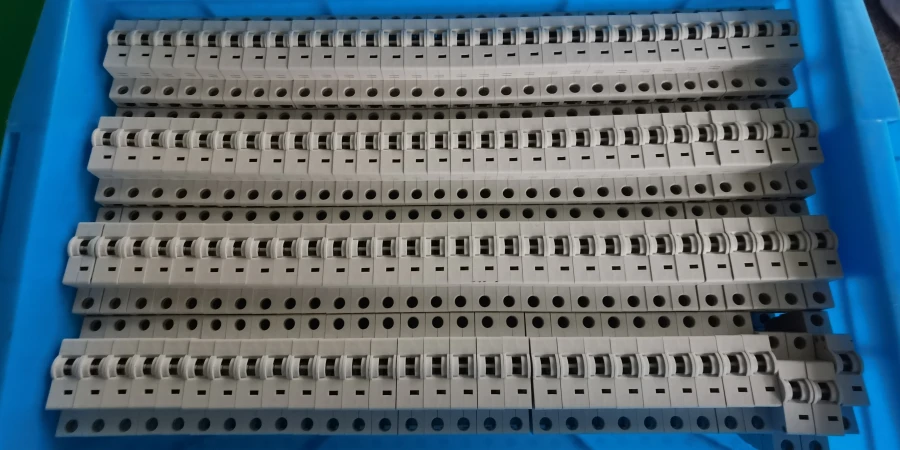
I spend most time dealing with customers — sending out samples, answering questions, and helping buyers work through problems that come up during the purchasing process. After enough years working in Yueqing’s electrical component cluster, you start to notice the same handful of problems coming up again and again, no matter which factory made the MCB.
Some of these issues are obvious the moment you open the box. Others stay hidden until the breaker has been running in a panel for months. Either way, they can cost you: warranty claims, failed inspections, or a fault that doesn’t clear the way it should.
These problems are not always easy to spot, especially when you are buying from a supplier for the first time. And in many cases, what looks fine on the surface may not tell you much about the actual quality of the breaker.
Incorrect Trip Characteristics
I get more complaints about this than almost anything else. A breaker may trip well below its rated current, fail to trip during a genuine overload, or simply behave outside the tolerance its trip curve is supposed to guarantee.
Manufacturing tolerance is one of the main reasons this happens. Even two breakers made from the same design can have noticeably different trip points if the factory doesn’t control things like bimetal thickness, spring tension, and magnetic release calibration closely enough. Thermal ageing can make the problem harder to catch, too, as repeated heating and cooling can gradually shift the bimetal’s trip point over time.
| Trip issue | Likely cause | Impact on Your Customers |
|---|---|---|
| Trips well below rated current | Bimetal miscalibration, weak spring tension | Nuisance trips, unnecessary downtime |
| Fails to trip during overload | Worn or misaligned thermal element | Cable and equipment left unprotected |
| Slow response to short circuit | Poor magnetic release calibration | Fault current allowed to persist too long |
| Inconsistent trip point batch to batch | Loose manufacturing tolerances | Unpredictable protection across a panel |
The good news is that this problem is not difficult to screen for before placing a large order. Start by asking the supplier for actual trip test data rather than relying only on the curve printed on the datasheet. For a first order, test several samples instead of just one, and check whether their trip points are consistent.
If you’re specifying a non-standard curve — say a Z-curve for sensitive electronics or a K-curve for motor loads — I’d be even more careful. Ask the supplier for actual test data and make sure the samples you receive match the required curve before moving on to a larger order.
Contact Quality Problems
Contact problems are among the most common reasons an MCB fails after installation. A breaker may work perfectly when it is new, pass a basic inspection, and still develop overheating or unreliable operation after months or years of service.
High contact resistance is usually the first sign of a problem in the contact system. When the contact surfaces do not close with enough pressure, when the plating is too thin or uneven, or when the contact material begins to oxidize, the resistance at the contact point increases.
This matters because heat generated at a resistive connection follows the I²R relationship. Even a small increase in contact resistance can create significant temperature rise when the breaker operates under continuous load. A breaker carrying 80% of its rated current should not develop abnormal heating after normal operation. If one pole consistently runs hotter than others in the same panel, the contact assembly deserves closer inspection.
However, contact resistance problems are not always caused by an issue that exists from the beginning. In many cases, they develop gradually as the breaker is used. Each switching operation creates mechanical stress and electrical stress on the contact surfaces. Over time, poor-quality contact materials, inaccurate contact alignment, or insufficient contact pressure can lead to pitting, uneven wear, and material erosion.
As the contact surfaces wear, the effective contact area decreases and the contact pressure may become unstable. This creates a cycle where wear increases resistance, higher resistance creates more heat, and additional heat accelerates further degradation of the contact system.
This is one reason why a new sample does not always reveal the real quality of an MCB. Two breakers may look identical on the outside and perform normally during initial testing, but their long-term reliability can be very different after hundreds or thousands of switching cycles.
For products that will operate continuously under load or experience frequent switching, I would not only check the datasheet. Ask the supplier about the contact material, plating thickness, contact construction, and whether the product has passed electrical and mechanical endurance testing according to the required standard.
Before placing a large order, it is worth testing multiple samples rather than relying on a single unit. Useful checks include temperature rise testing, contact resistance measurement, and endurance test records. The goal is not just to confirm that the breaker works when new, but to verify that the contact system can maintain reliable performance throughout its expected service life.
Mechanical Defects in the Latch or Operating Mechanism
A breaker that sticks, won’t reset cleanly, or trips falsely without a real fault present is usually suffering from a mechanical problem rather than an electrical one.
Weak springs, misaligned linkage parts, or burrs left over from stamping and molding can all interfere with the mechanism. A handle that feels stiff, doesn’t return smoothly to an ON or OFF position, or requires extra force to reset is a warning sign.
Cheap plastic parts can make the problem worse over time. Repeated operation can cause thin or brittle components to crack, while a damaged internal guide can change the movement of the linkage and lead to intermittent failures that are difficult to reproduce during a quick test.
The easiest first check is a simple one: operate the breaker by hand and pay attention to the feel of the handle. It should move smoothly and consistently, with clear ON, OFF, and reset positions. If samples from the same batch feel noticeably different, that’s a reason to look closer.

For larger orders, ask whether the factory performs mechanical endurance testing and how many operating cycles they test. You can also check several units from the production batch rather than relying on a single sample. Mechanical defects are often easier to catch through consistency checks than through a single functional test.
Poor Arc-Chute Construction or Weak Arc-Extinguishing Performance
This is one of the most serious problems during an actual short-circuit event, and also one of the hardest to evaluate without proper test equipment.
Poor arc-chute assembly, undersized arc runners, or low-quality insulating materials can reduce the breaker’s ability to control the arc during a fault. The result can be excessive internal arcing, carbon tracking, contact damage, or even welded contacts.
This is directly related to the breaker’s stated breaking capacity. If the available fault current at the installation exceeds what the breaker was actually designed and tested to handle, the damage can be much more serious than a simple nuisance trip.
| Symptom after a fault event | Usually points to |
|---|---|
| Discoloration or carbon tracking inside the housing | Weak arc extinction or poor arc-chute construction |
| Contacts welded shut | Breaking capacity exceeded or poor contact material |
| Breaker won’t reset after clearing a fault | Internal mechanical damage from excessive arc energy |
| Burnt smell without visible external damage | Internal arcing not fully contained |
This is difficult to judge from a sample or datasheet alone. For this reason, ask the supplier for a genuine short-circuit type test report for the exact model and rating you’re ordering. A general certificate covering an entire product family doesn’t tell you nearly as much.
For a first order, I’d also pay attention to whether the supplier can clearly explain the test conditions and provide traceable test documentation. If they can’t show how the exact model was tested, I wouldn’t rely on the breaking-capacity number printed on the label alone.
Insufficient Insulation Quality or Internal Contamination
A breaker’s plastic housing does more than hold the parts together — it’s the primary barrier keeping live internal components isolated from each other and from anyone touching the outside of the case.
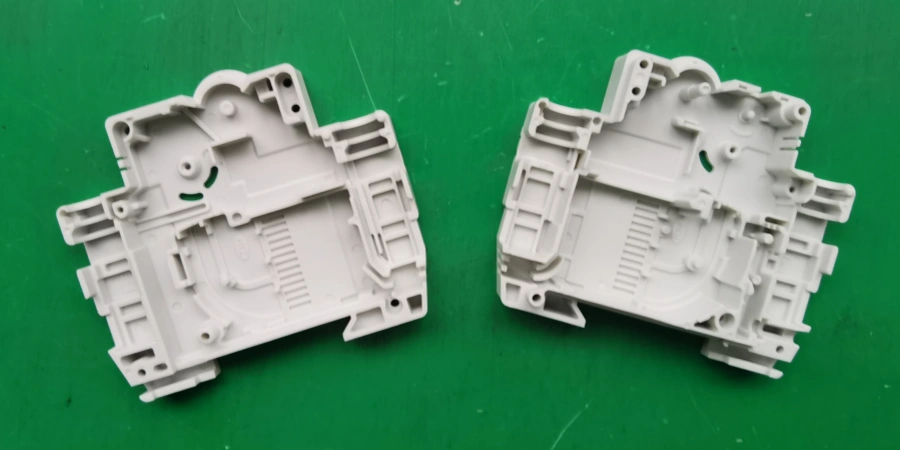
Low-grade molding compound, voids left in the plastic during molding, or contamination trapped inside the housing during assembly can all reduce insulation performance. Moisture ingress over time can make the problem worse, especially in humid climates or outdoor enclosures.
The practical risk is a reduction in insulation resistance, which increases the chance of tracking and, in severe cases, flashover between live parts. You often can’t catch this by looking at a finished breaker — the housing may look perfectly fine externally while the internal insulation has already been compromised.
The first step is to check the materials used for the insulation parts and how the factory controls the production process. Ask what type of plastic is used for the housing and how the factory controls moisture and contamination during molding and assembly.
For the actual order, ask the supplier for recent insulation resistance and dielectric withstand test results from the production batch you’re buying, rather than relying only on an old certificate. If the product will be used in humid or outdoor environments, also confirm that the materials and product are suitable for those conditions.
If the factory can provide clear batch-level test records and explain how it controls cleanliness during molding and assembly, you have a much better basis for judging insulation quality than a visual inspection alone.
Inconsistent Component Dimensions and Assembly Tolerances
One breaker from a batch performs perfectly. The next one, built from the same bill of materials, doesn’t. This is almost always a tolerance problem rather than a design problem.
Every internal part in an MCB — the bimetal strip, the contact assembly, the latch components, the coil — has a specified dimensional and tolerance range. When a factory’s process control is loose, individual parts can drift toward the edges of their tolerance range. Once those parts are assembled together, small deviations can stack up and affect the final performance.
For example, a contact gap that’s slightly too wide combined with a slightly weak spring can make the breaker’s trip point or contact pressure noticeably different from the specification. Each individual part may have passed inspection on its own, but the assembled breaker can still perform differently.
This is a particular concern for SKD or CKD buyers assembling breakers locally from imported components. If component dimensions vary too much between batches, it becomes much harder to maintain a stable assembly process and consistent final products.
To reduce this risk, ask the supplier for the key dimensional tolerances of the components you’re buying and how they control them during production. For SKD or CKD orders, it’s especially useful to measure samples from different production batches before shipment and compare the results, rather than checking only one batch.
If you’re assembling locally, set consistent measurement points and acceptance limits for each incoming batch. When the reject rate suddenly increases, compare the dimensions of the rejected parts with an earlier batch. This can help determine whether the problem comes from dimensional variation in the supplier’s components or from significant tolerance differences between production batches.
Inadequate Quality Control at Terminals, Screws, and Connection Points
Terminal problems are unglamorous, and that’s exactly why they get overlooked. But a high-resistance joint at the terminal behaves the same way as one inside the breaker: it overheats under continuous load.
Soft or low-grade screw metal can strip under torque, shallow thread engagement can let a screw loosen over time and vibration, and weak clamp designs may not grip the conductor evenly across the contact surface. Any of these can create a connection point with more resistance than it should have, turning that resistance into heat where you’re least likely to notice it — often hidden under wiring inside a panel.
The easiest way to reduce this risk is to look beyond the finished product and ask how the factory controls the terminals and connection points during production. Ask about incoming material inspection, in-process checks during assembly, and final inspection before shipment. A supplier that can clearly explain these controls gives you a much better idea of how consistently the terminals are being made.
For a first order, it’s also worth checking several samples rather than relying on one unit. Pay attention to screw quality, thread engagement, terminal construction, and whether the screws and clamps feel consistent from unit to unit. If possible, check the same points on samples from different production batches.
I’d also treat a price that sits far below the rest of the market as a reason to ask more questions, not fewer. Lower prices can come from many places, but when you’re dealing with components such as screws, terminals, and connection parts, cutting material or process controls can eventually show up as a quality problem.
Final Thoughts
A quality problem becomes much more expensive once the products are already in your warehouse or, worse, in your customer’s hands. That is why the best time to look for potential problems is before production starts.
When you understand what to check and what questions to ask, supplier discussions become more practical, and there is less room for unpleasant surprises later.